

Beschreibung
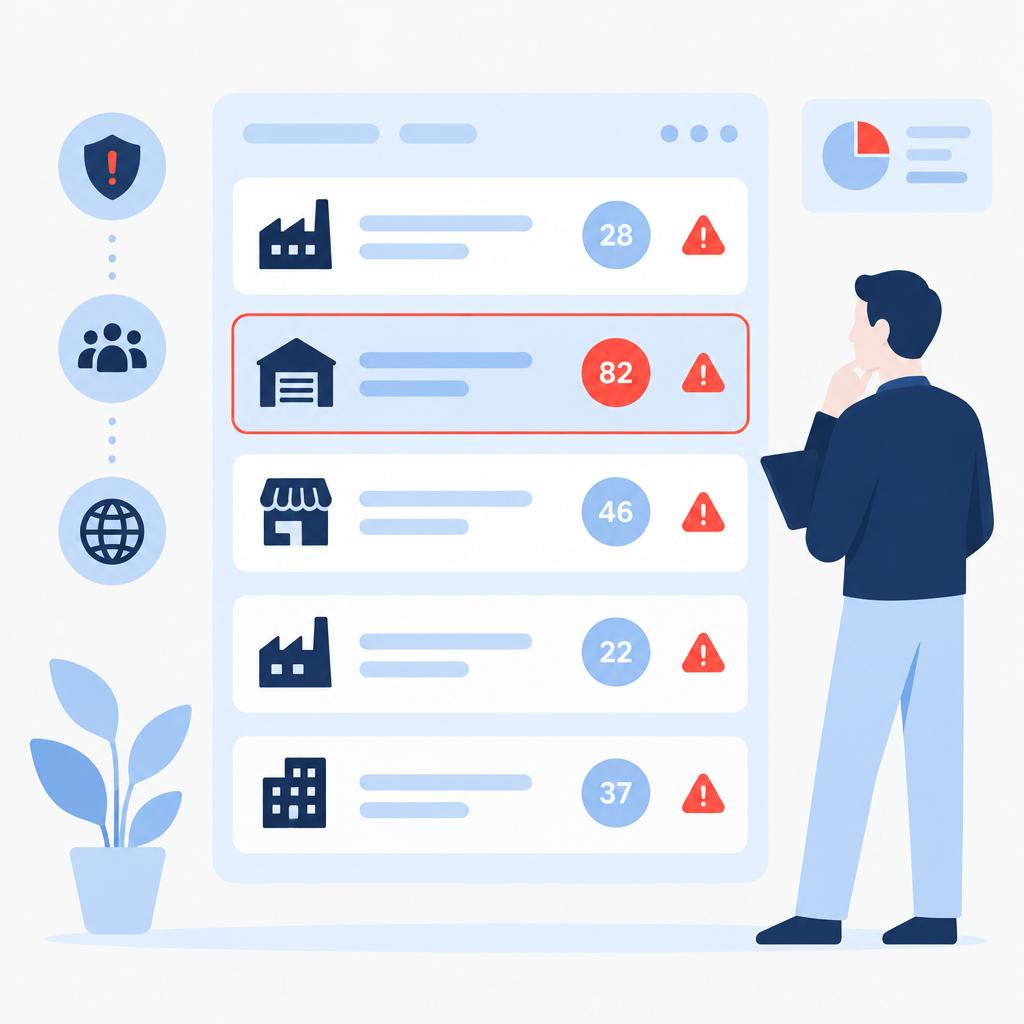
The AI Supplier Risk Monitor & Alert Manager continuously evaluates your supplier base for payment anomalies, delivery failures, negative public signals and contract expiries. It consolidates data from procurement, ERP and accounting systems plus optional external sources to produce a single, prioritized risk view.
implementi.ai configures, operates and maintains the monitoring service: we connect agreed systems, run the ongoing AI analysis, surface prioritized alerts and handle automation failures so your teams receive only relevant, timely warnings they can act on.
Das Problem
Many companies rely on periodic manual checks, spreadsheets and siloed systems to judge supplier health. Payment delays, repeated delivery exceptions and sudden negative news are detected late because signals are scattered across AP aging reports, procurement records, delivery logs and public feeds. As supplier lists grow, manual monitoring becomes time-consuming and noisy: teams spend effort chasing low-priority items while high-risk suppliers slip through. Without continuous synthesis and prioritisation, mitigating actions arrive after a problem impacts operations or cashflow.

Was diese Lösung automatisiert
This service automates continuous surveillance and prioritised alerting of supplier risk. It standardises signals from your business systems and external sources, ranks suppliers by risk level, and routes high-priority issues to the right stakeholders.
- Automated supplier risk scoring using payment patterns, PO/Invoice mismatches and delivery exceptions.
- Watchlist creation and real-time alerts for suppliers that breach custom thresholds.
- Auto-tagging and enrichment of supplier master data for faster triage.
- Scheduled summary reports and drill-downs for procurement and finance reviewers.
- Exception routing to designated approvers or teams with contextual evidence.
- Ongoing tuning of rules and AI model behaviour as the supplier base evolves.
Was Ihr Unternehmen davon hat
- Earlier detection of supplier deterioration. Continuous monitoring captures payment slowdowns, delivery failures and emerging public signals earlier than periodic reviews, allowing teams to take mitigation steps sooner.
- Prioritised, actionable alerts. The service filters noise and escalates only high-impact issues so procurement and finance spend time on suppliers that matter.
- Consolidated supplier view. Data from ERP, AP, procurement and external feeds is combined into a single risk profile, removing the need to cross-check multiple systems manually.
- Lower operational overhead. Automating routine checks and routing exceptions reduces manual work and helps small teams manage larger supplier portfolios without proportional headcount increases.
- Maintained and tuned over time. implementi.ai operates and updates the monitoring logic and integrations monthly so the solution keeps working as systems and supplier behaviour change.

Ein praktischer Anwendungsfall
For example, a mid-sized manufacturer with hundreds of suppliers wants to avoid production delays caused by single-source vendors. The monitor ingests AP ageing, PO receipts and delivery exception feeds, alongside public trade filings and news alerts. When a major supplier shows widening payment delays and an uptick in late deliveries, the system raises a high-priority alert to procurement and finance, bundles supporting evidence, and suggests temporary purchasing restrictions until the supplier’s status is confirmed. Procurement can then open mitigation measures while finance reviews payment terms.
Für wen ist es gedacht?
- Procurement teams at manufacturing or distribution firms — need early warning on suppliers that affect production continuity.
- Finance and AP teams — require visibility into payment behaviour and supplier credit risk to manage cashflow exposure.
- Small centralised operations teams — want to monitor a large supplier base without adding headcount.
- Compliance or vendor-management functions — need an auditable trail of risk signals and alerts to support contract decisions.
Was ist im monatlichen Service enthalten?
The monthly subscription covers the operated monitoring service: established connections to agreed systems, ongoing AI processing and risk scoring, monitoring of automation health and handling/fixing of integration or processing errors. implementi.ai maintains the solution and performs reasonable configuration updates to keep alerts and thresholds aligned with your changing supplier base.
- Operating automation and AI analysis.
- Connections with systems agreed before launch.
- Monitoring, error handling and maintenance.
- Reasonable monthly configuration updates and tuning.
Wann diese Lösung möglicherweise nicht erforderlich ist
- Companies with very small supplier lists (under ~20 suppliers) and no history of supplier issues — manual oversight may be sufficient.
- Organisations requiring deep legal or credit underwriting beyond the scope of monitored signals — those need specialised credit providers.
So funktioniert es
- Connect your systems. We agree which systems to integrate (ERP/AP/procurement, spreadsheets, third‑party feeds) and configure secure, read-only data access where possible or agreed methods of transfer.
- Initial data normalisation. Supplier master records, PO and invoice data are matched and normalised so that disparate identifiers map to single supplier profiles for reliable scoring.
- Baseline scoring and thresholds. The service runs an initial analysis to establish baseline risk signals and suggested alert thresholds; these are tuned with your team before live monitoring starts.
- Continuous signal aggregation. On a scheduled cadence (daily or agreed frequency) the automation ingests new invoices, payment events, delivery exceptions and external signals to update supplier profiles.
- AI risk scoring and prioritisation. The AI synthesises signals into a compact risk score and ranks suppliers; high-priority cases are routed as alerts with supporting evidence and suggested next steps.
- Alert routing and human review. Alerts are delivered to designated stakeholders or systems (email, Slack, procurement ticketing); reviewers can confirm, downgrade or request further investigation, which is recorded back into the supplier profile.
- Ongoing tuning and maintenance. implementi.ai monitors automation health, addresses integration errors, and applies configuration updates to thresholds and enrichment logic as your business evolves.
Beispiel-Workflow
For example, imagine a company that sources parts from 250 suppliers. Overnight the monitoring service ingests AP aging, several late-delivery records from the WMS and an external trade-news feed reporting operational issues at one supplier. The AI correlates a pattern of increasing invoice days outstanding plus delivery exceptions and raises a high-priority alert for that supplier, including PO, invoice and delivery evidence. Procurement receives the alert, places the supplier on a temporary watchlist and opens alternative purchase orders. Finance flags outstanding payments for manual hold pending confirmation. The result is a coordinated mitigation action initiated before the supplier failure disrupts production.
Integrationen
Typische Systeme
Typical systems may include ERP and accounting platforms (SAP, Oracle NetSuite, Microsoft Dynamics, Xero, Sage), procurement/e‑procurement tools (Coupa, Ariba), warehouse or TMS delivery feeds, AP systems and spreadsheets or Google Sheets. External data examples are public company registries, trade news APIs and commercial credit feeds. Other systems can potentially be connected and compatibility is confirmed before implementation.
Anschlussarten
Connections are implemented using available APIs or native integrations where supported, webhooks for real‑time events, secure file transfer (SFTP) or scheduled CSV exports, email-inbox parsing for invoice notifications, and Google Sheets for lightweight data exchange. Exact methods are agreed during scoping and depend on the systems you use.
Was wir von Ihrem Unternehmen benötigen
Before launch we agree the systems to be connected, sample data extracts (supplier master, AP ledger, PO/delivery records), desired alert recipients and the decision/approval rules to apply for escalations. We also need to define risk thresholds and any blocked-payments or procurement-block rules. Compatibility, access method and the final scope are confirmed before implementation.
Häufig gestellte Fragen
Which systems can you connect to for supplier data?
We typically connect to ERP, AP, procurement and WMS/TMS systems via APIs, scheduled CSV exports or secure file transfer. We verify compatibility for your specific platforms during scoping.
Can thresholds and risk rules be customised?
Yes — thresholds, watchlists and escalation rules are configured with your team and can be adjusted over time. implementi.ai applies reasonable configuration updates as part of the monthly service.
Wie wird mit Fehlalarmen umgegangen?
Alerts include supporting evidence and a confidence indicator so reviewers can triage quickly. You can mark alerts as false positives, and we will tune the detection rules and model behaviour to reduce similar noise.
Do you keep a history of supplier scores?
Yes — the solution maintains supplier history and trend data so changes in risk profile are visible over time. The retention approach is agreed before implementation.
What affects the monthly price?
Price reflects the number and type of integrations, processing frequency, external data feeds and the effort required to maintain custom scoring and alerts. We confirm the final subscription details after scoping.
Preis
Die Aktivierungsgebühr deckt die Ersteinrichtung, die Implementierung und die Inbetriebnahme des vereinbarten Automatisierungsumfangs ab.
Das monatliche Abonnement umfasst den laufenden Betrieb, die Wartung und die Verwaltung des Automatisierungsdienstes.
Der genaue Umfang und die endgültige monatliche Abonnementgebühr werden vor dem Start bestätigt.
Sind Sie bereit, diesen Prozess zu automatisieren?
Tell us which ERP, procurement and AP systems you currently use and roughly how many active suppliers you manage.
Wir werden klären, wie diese Lösung angeschlossen werden kann, welchen Umfang sie hat und wie hoch die monatliche Abonnementgebühr letztendlich sein wird.
Buchen Sie ein 30-minütiges Telefonat
| Schreiben Sie uns eine E-Mailcontact@implementi.ai | Rufen Sie uns an+48 660 983 178 |