
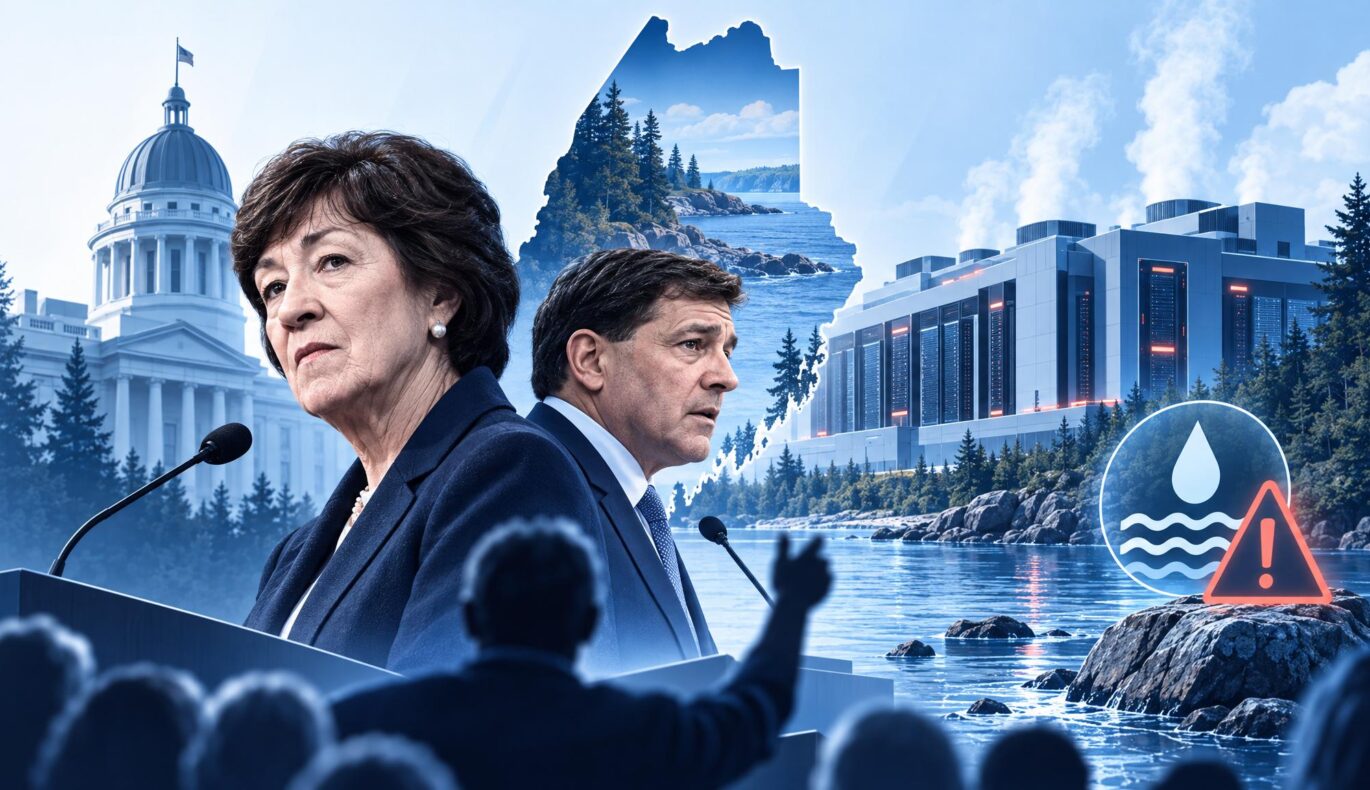
Maine’s 2026 Senate race has turned the expansion of AI data centers into a major campaign issue, putting Republican Sen. Susan Collins and Democratic challenger Troy Jackson under pressure to address local concerns. The debate matters beyond Maine: data centers require substantial resources, and public opposition could influence how communities and politicians approach AI infrastructure.
Why Maine’s data centers became a Senate issue
The Verge reports that an audience member interrupted a final debate by warning that AI data centers were harming the climate and contaminating water. Collins rejected the interruption and connected the speaker to Jackson, but the incident reflected broader anxiety about the rapid growth of data-center projects in the state.
The source also says Maine attracted national attention in April over data centers, although the supplied material does not provide enough detail to establish which project, decision, or regulatory change triggered that attention. It likewise does not confirm that data-center opposition will determine control of the US Senate. The headline presents that as the political stakes, not as a verified election result or forecast.
What AI data centers change for businesses and communities
AI data centers are facilities used to run the computing workloads behind artificial-intelligence systems. The supplied reporting does not specify the technology, operators, power consumption, water use, environmental measurements, or proposed capacity involved in Maine, so those details remain unanswered.
For businesses and developers, the practical issue is infrastructure dependency rather than a newly announced software feature. More local computing capacity could support future AI services, but construction and operation can also raise questions about electricity demand, water resources, emissions, land use, and who pays for related infrastructure. None of those tradeoffs is quantified in the available source.
What companies should watch next
Teams considering AI deployments should not treat political attention as proof that new capacity is available or that costs and environmental impacts have been resolved. A hypothetical Maine startup evaluating an AI workload might need to compare cloud providers, local infrastructure, energy disclosures, and continuity risks before committing to a deployment; the source does not establish that any such options currently exist in Maine.
The immediate next step is to distinguish campaign claims from documented project facts. Voters, operators, and businesses will need clearer information on proposed data centers, permits, water and power requirements, ownership, and accountability before the debate can move from fear and political positioning to evidence-based decisions.
Quelle: Ursprüngliche Berichterstattung. Dieser Artikel enthält unabhängige redaktionelle Hintergründe und praktische Analysen.
Weitere Einblicke in die KI: Stöbern Sie in unserem Aktuelle Artikel zu KI-Automatisierung und -Technologie, oder entdecken Sie gebrauchsfertige Automatisierungslösungen.