

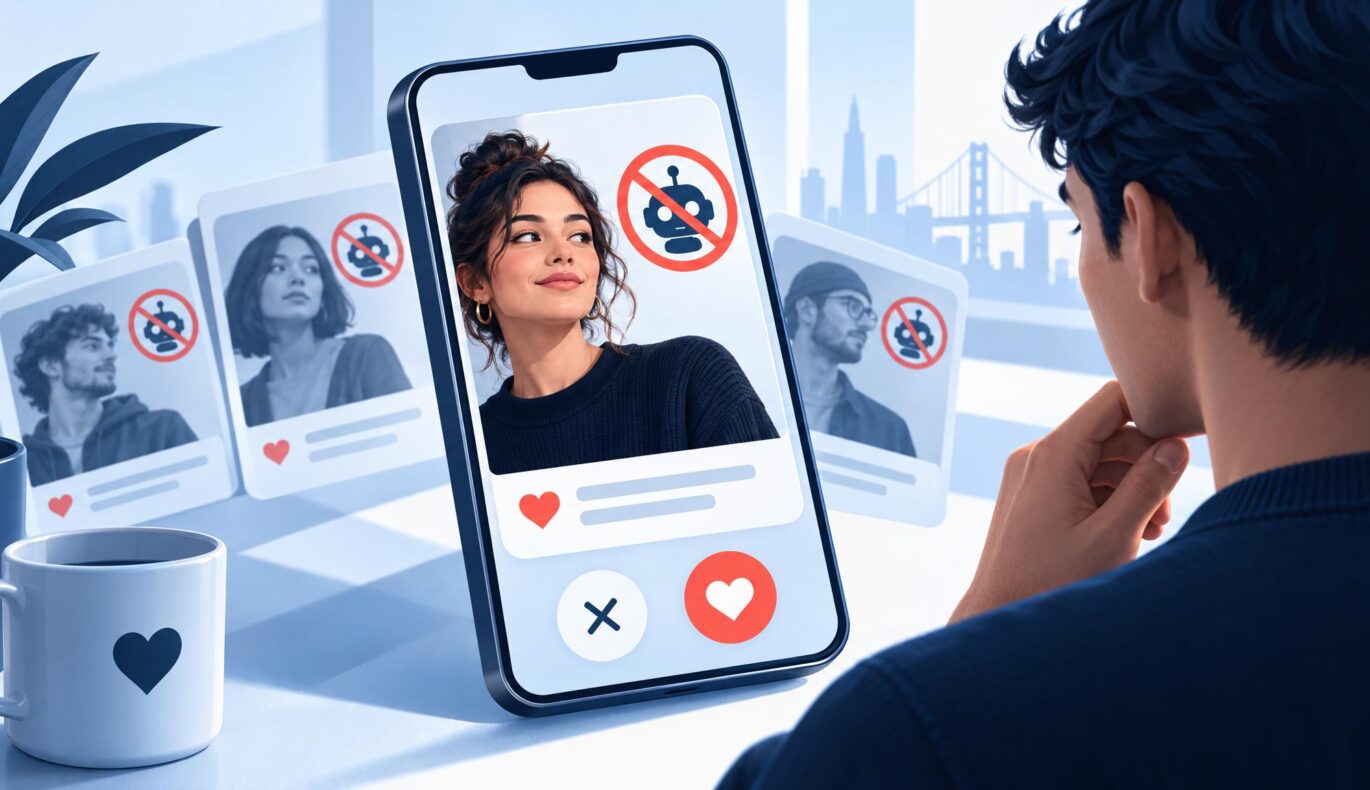
Artificial intelligence is becoming a stated dating preference for some people on Hinge, with profiles explicitly rejecting AI as a condition for compatibility. The pattern, described by The Verge through the experience of San Francisco analyst Irene, matters because attitudes toward AI may now shape personal relationships as well as workplace and political choices.
How AI is appearing in dating profiles
Irene noticed people using Hinge’s “We’ll get along if” prompt to write statements such as “Fuck AI.” The profiles she encountered were often from people working in areas including the arts, nursing, and graphic design, according to the report.
The source supports a narrower conclusion than the headline might suggest: some Hinge users are treating views about AI as a dating dealbreaker. It does not establish how common this is across Hinge, other dating platforms, cities, age groups, or countries. Nor does it show that Hinge has introduced an AI-specific feature, filter, policy, or recommendation system.
What “AI as a dealbreaker” could mean—and what is unclear
The reported profile statements appear to function as personal value signals, allowing users to screen for shared attitudes before starting a conversation. The source does not explain whether these users oppose generative AI generally, specific applications of it, workplace automation, AI companies, or a particular social and environmental concern.
There is also no confirmed information here about how dating apps handle AI-related profile content, whether users disclose AI assistance in messages or profile writing, or what privacy and safety controls apply. The report does not provide evidence of an AI-driven rollout, eligibility rules, geographic expansion, performance data, or a platform response.
Implications for teams and developers
For businesses building consumer AI or workplace tools, the anecdote is a reminder that adoption can become part of a person’s identity and social compatibility—not merely a productivity decision. Teams should avoid assuming that enthusiasm for an AI feature is universal, especially among workers whose jobs or creative practices may be affected by automation.
For example, a small design agency considering AI-assisted drafting might hypothetically face internal disagreement not only about output quality, but also about professional values and client expectations. A responsible workflow could make tool use visible, define where human review is mandatory, and let clients or collaborators set boundaries rather than treating adoption as automatic.
Developers should treat this as a signal to investigate, not as proof of a widespread consumer trend. The practical next step is to ask users what they mean by “AI,” provide clear disclosure around automated assistance, and measure attitudes across a representative audience before making product or marketing decisions.
Quelle: Ursprüngliche Berichterstattung. Dieser Artikel enthält unabhängige redaktionelle Hintergründe und praktische Analysen.
Weitere Einblicke in die KI: Stöbern Sie in unserem Aktuelle Artikel zu KI-Automatisierung und -Technologie, oder entdecken Sie gebrauchsfertige Automatisierungslösungen.