


Beschreibung
The AI Fulfilment SLA Monitor continuously tracks promised fulfilment and shipping deadlines across your order management, warehouse and carrier systems. It identifies orders at risk of missing milestones and triggers automated reassignment, carrier swaps or escalation messages so operations teams act before customers are affected.
implementi.ai operates and maintains the end‑to‑end automation: we configure the monitoring rules, connect agreed systems, keep the logic tuned and handle operational errors so your team receives only meaningful exceptions and recommended actions.
Das Problem
Many businesses rely on manual checks or static dashboards to detect late fulfilment. As order volumes, SKUs and fulfilment locations grow, it becomes impossible for staff to spot the handful of orders that will miss SLA windows. Missed ship dates trigger customer contacts, rush shipping, rework and loss of trust; teams waste time triaging orders rather than preventing delays. Data about order status, picking progress, carrier cutoffs and exceptions typically lives in multiple systems, so detecting risks requires continuous cross-system checks and consistent business rules.

Was diese Lösung automatisiert
This managed solution automates continuous SLA monitoring, risk scoring and corrective actions across order, warehouse and carrier systems. The service watches defined SLA milestones and applies configurable rules to reassign or escalate orders before deadlines are missed.
- Continuous risk scoring for fulfilment, pick, pack and carrier handover milestones.
- Automated reassignment of orders to alternate warehouses or carriers when rules trigger.
- Carrier change suggestions based on transit options, cut-off times and cost rules (decision left to configured automation).
- Automated notifications or task creation for human approvers when exceptions require intervention.
- Maintained history of SLA breaches, reassignment actions and outcomes for auditing and tuning.
Was Ihr Unternehmen davon hat
- Fewer late shipments. The system detects orders at risk well before SLA targets are missed and either corrects routing or prompts timely human action, reducing reactive rushes and expedited shipping.
- Lower manual triage load. Automation filters out routine status updates and surfaces only actionable exceptions, freeing operations staff to handle only the genuinely complex cases.
- Improved cross-system visibility. Consolidated SLA scoring across OMS, WMS and carrier feeds reduces blind spots and shortens decision cycles for rerouting orders.
- Consistent decision rules. Configurable policies enforce the same reassignment and escalation logic across teams and shifts, avoiding ad-hoc, error-prone choices.
- Operational learning. Maintained history enables tuning of SLA thresholds and more reliable reassignment rules over time.
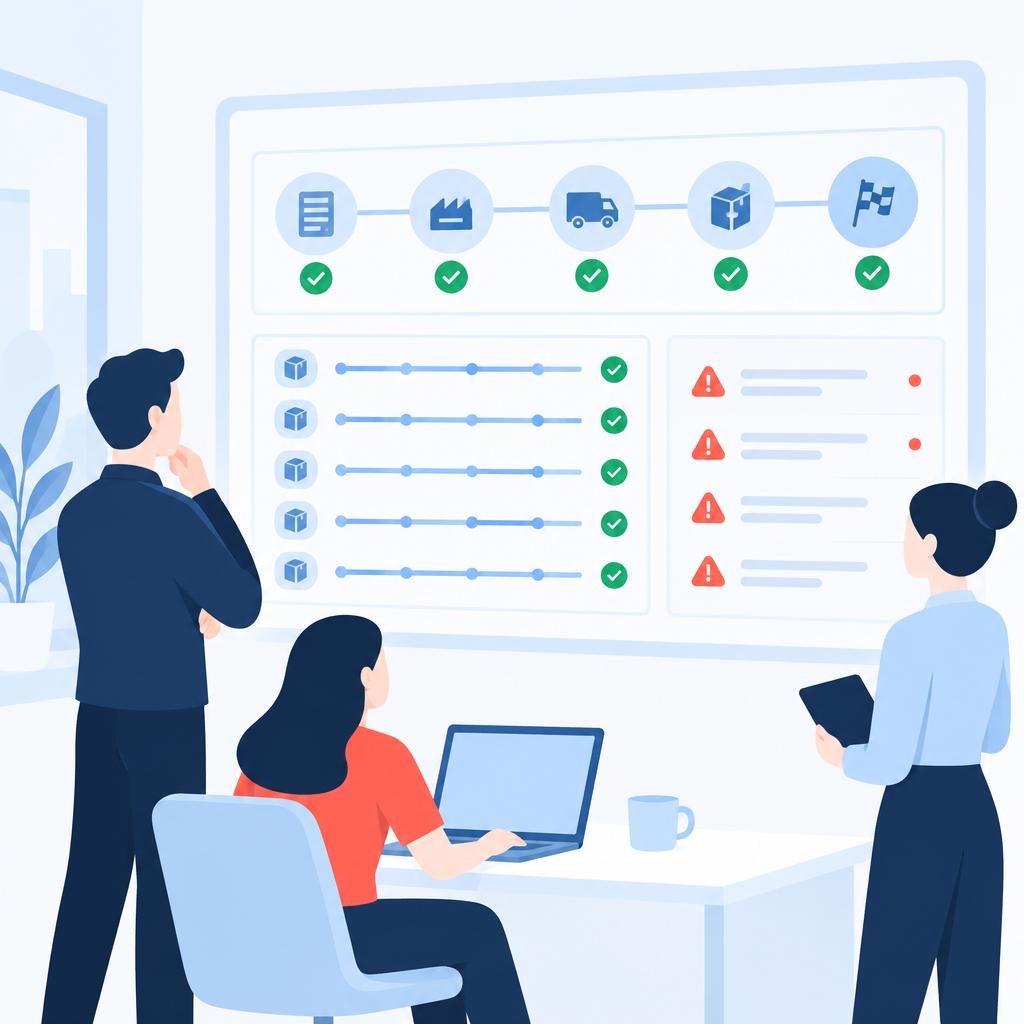
Ein praktischer Anwendungsfall
A mid-size online retailer operates three fulfilment centres and sells through a web storefront plus marketplaces. During peak weeks, certain SKUs sell out in one centre while another location has stock but different carrier contracts. The SLA Monitor continuously checks pick and handover milestones; when a promised ship-by time looks at risk due to delayed picking, the system evaluates alternate warehouses and carrier options and either triggers an automated reassignment to a nearer fulfilment centre or creates a single exception task for a supervisor to approve a carrier swap. The result is fewer late shipments and clearer operational workload during peaks.
Für wen ist es gedacht?
- Multi-warehouse e-commerce retailers that need to reduce late deliveries and rework.
- Third‑party logistics providers (3PLs) managing multiple clients and carrier contracts, requiring consistent SLA enforcement.
- Retail operations teams expanding to marketplaces and needing automated, rules-based reassignment across fulfilment locations.
- Companies with mixed systems (OMS, WMS, ERP) that need a managed, continuous monitoring service rather than internal scripting.
Was ist im monatlichen Service enthalten?
The monthly subscription covers the managed automation and operational upkeep needed to keep SLA monitoring running reliably. implementi.ai configures the monitoring rules, connects the agreed systems before launch and maintains and updates the automation while it runs.
- Operating the automation and periodic tuning of SLA rules and thresholds.
- Connections with systems agreed and confirmed before launch.
- Ongoing AI processing and decision‑support where the product requires it.
- Monitoring of automation health, handling and fixing integration errors and reasonable configuration updates to keep the solution working.
Wann diese Lösung möglicherweise nicht erforderlich ist
- Very small sellers with low daily order volumes and a single fulfilment location — manual monitoring may be sufficient.
- Operations that require custom on-premise middleware with strict internal control and no third‑party integrations; compatibility is confirmed before launch.
So funktioniert es
- Connect order and fulfilment sources. We link the order management system, warehouse systems and carrier feeds agreed during scoping so the automation receives order lifecycles and milestone timestamps.
- Define SLA milestones and business rules. We configure the monitoring thresholds (pick start, pack complete, carrier handover, promised ship date) and the decision rules that determine reassignment or escalation.
- Continuous risk scoring. The service monitors active orders and scores each against SLA timelines and current progress; scores update as new events arrive from integrated systems.
- Apply corrective actions. When an order crosses a risk threshold, the automation evaluates alternatives (other warehouses, available carriers) and either enacts a configured reassignment or generates an approval task for a human operator, depending on your rules.
- Notify and log outcomes. The system sends pre-configured notifications to operations staff for approvals and logs all reassignment decisions and outcomes so teams can review and refine rules.
- Exception handling and human loop. Complex exceptions (inventory discrepancies, blocked SKUs) are routed to named handlers with context and suggested actions, reducing investigation time.
- Laufende Optimierung und Unterstützung. implementi.ai monitors automation health, tunes risk thresholds based on outcomes and fixes integration errors as part of the monthly service.
Beispiel-Workflow
For example, imagine a company that sells seasonal electronics from three warehouses. An order with a two‑day ship SLA is accepted, but picking at Warehouse A is delayed due to a staffing issue. The monitor ingests pick and pack timestamps, scores the order as ‘high risk’ as the handover window approaches, and evaluates inventory at Warehouses B and C. Warehouse B has stock and an earlier carrier cutoff; based on configured rules the automation either triggers an automatic reassign to Warehouse B using existing fulfilment rules or creates a single approval task for a supervisor to confirm the carrier swap. The order is re-routed before the SLA is missed and the customer receives the expected delivery window.
Integrationen
Typische Systeme
Typical systems that customers connect include order management and e-commerce platforms (for example Shopify, Magento, platform OMS modules), warehouse management systems (WMS) or inventory services (example vendors: Blue Yonder, Manhattan), ERP systems (example vendors: SAP, NetSuite) and carrier APIs or shipping platforms (DHL, UPS, FedEx, or aggregator services). Other operational tools such as task managers or internal dashboards can also be integrated where useful. Specific compatibility is confirmed during scoping.
Anschlussarten
Connections are implemented using agreed methods such as platform APIs and webhooks, carrier APIs or shipping platform integrations, scheduled CSV/SFTP exports, database access or secure connector tools. We select the safest practical method for each system during the discovery phase; compatibility and the final connection method are confirmed before launch.
Was wir von Ihrem Unternehmen benötigen
Before launch we agree which systems to integrate, the data fields and event triggers to monitor (orders, pick/pack timestamps, carrier handovers), your SLA milestones and acceptable reassignment/escalation rules. We also need contacts for operations and IT for initial access and testing, plus a sample of data or API credentials in a test environment. Final compatibility and access details are confirmed prior to implementation.
Häufig gestellte Fragen
An welche Systeme können Sie eine Verbindung herstellen?
We can connect to most OMS, WMS, ERP and carrier APIs, plus CSV or SFTP exports and webhook feeds. During discovery we confirm the exact systems and the preferred connection methods for your environment.
How are SLA thresholds and reassignment rules defined?
Thresholds and rules are configured during scoping with your operations team. Rules can be fully automated for routine cases or set to create approval tasks when human sign-off is required.
What happens when the automation cannot decide?
When the system encounters ambiguous or high‑risk exceptions it creates a single, contextual task for an assigned human approver with suggested actions and the relevant order context to speed a decision.
How does tuning and ongoing support work?
implementi.ai monitors automation health, tunes thresholds based on observed outcomes and fixes integration issues as part of the monthly managed service. Any substantial rule changes are agreed and scheduled with your team.
Wovon hängt der monatliche Preis ab?
Pricing depends on the number and type of integrations, monitoring frequency, the volume of orders processed, and the level of customized decision logic and history the solution maintains. These factors are reviewed during scoping and reflected in the subscription tier.
Wie beginnen wir mit der Umsetzung?
We begin with a discovery call to map systems, order volumes and SLA rules. Launch time depends on the integrations and scope; we confirm a plan and timeline before starting work.
Preis
Die Aktivierungsgebühr deckt die Ersteinrichtung, die Implementierung und die Inbetriebnahme des vereinbarten Automatisierungsumfangs ab.
Das monatliche Abonnement umfasst den laufenden Betrieb, die Wartung und die Verwaltung des Automatisierungsdienstes.
Der genaue Umfang und die endgültige monatliche Abonnementgebühr werden vor dem Start bestätigt.
Sind Sie bereit, diesen Prozess zu automatisieren?
Tell us which order management, warehouse and carrier systems you use and your typical daily order volume.
Wir werden klären, wie diese Lösung angeschlossen werden kann, welchen Umfang sie hat und wie hoch die monatliche Abonnementgebühr letztendlich sein wird.
Buchen Sie ein 30-minütiges Telefonat
| Schreiben Sie uns eine E-Mailcontact@implementi.ai | Rufen Sie uns an+48 660 983 178 |