
The Power of Pointing: Adapting to Language Barriers While Travelling
So, you’ve spent hours learning key phrases, regularly practising with language learning apps, and even indulging in the cuisine of your destination to acquaint your tongue with the taste of different names. Ready to embark on your Italian adventure, you are convinced that language will not be a barrier. However, there’s always that moment of sheer communication breakdown no matter how well-versed we become in a foreign language.
Picture this scenario. You’re onboard a high-speed train, zigzagging through the scenic routes of northern Italy. With each passing moment, Firenze Santa Maria Novella grows distant, as you venture closer to Venezia Santa Lucia station. Your smartwatch subtly reminds you that twenty-five minutes are left until the completion of this two-hour train journey.
The anticipation surges among your family members. Their excitement is palpable, their noisy chatter bouncing off the metallic walls of the train. Suddenly, the peace is shattered by a surge of anxiety – the train seems to be approaching the final stop much quicker than your smartwatch predicted. You think that you have missed your stop, yet you struggle to communicate this worry to the train staff in a language new and foreign to your tongue.
In such moments, gestures often prove to be a saving grace. Enter the power of pointing. This simple human gesture surpasses the need for language and enables us to communicate universally. Whether you’re ordering your favourite dish at a roadside cafe in Naples or trying to find your way around the winding streets of Rome, never underestimate the power of pointing.
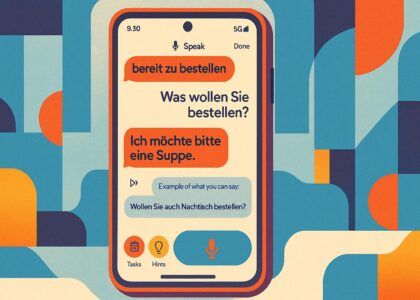
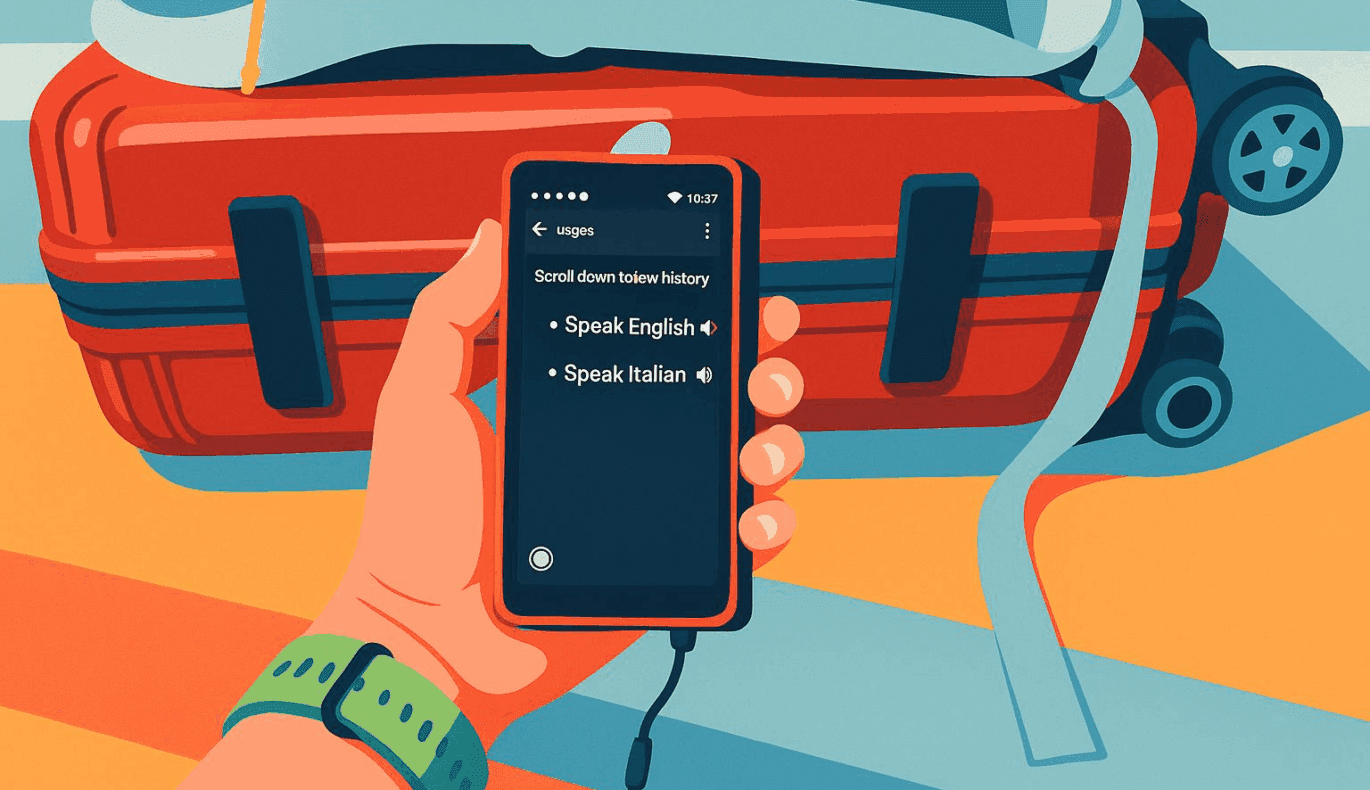
The complexities of human communication are often simplified through these non-verbal cues. Recent tech advances have also brought forth efficient translation tools such as the TimeKettle T1. With a set capacity for English and Italian, these tools aim to make language barriers a thing of the past enabling us to have smoother cultural exchanges.
So, it is no surprise then, that while our tongues may falter and sweat may bead on our foreheads as we grapple to ask for directions or the local bus schedule, we instinctively resort to universal signs of communication. While technology advances and as AI continues to bridge these verbal gaps, the age-old adage still rings true: actions do speak louder than words. And sometimes, these actions can simply be a pointed finger.
Real life situations, like the one experienced on an Italian train, are reminders of the importance of non-verbal cues in human interaction. However, as language translator devices grow more sophisticated and accessible, the way we navigate foreign lands and engage with global cultures may drastically evolve. It will be interesting to see how technology affects our reliance on the power of simple human gestures. Yet, the act of pointing will always hold its place as a fundamental human communication tool in the game of languages – the universal language that we all innately understand and can never forget.
Visit the full story at The Verge for more insightful stories.