

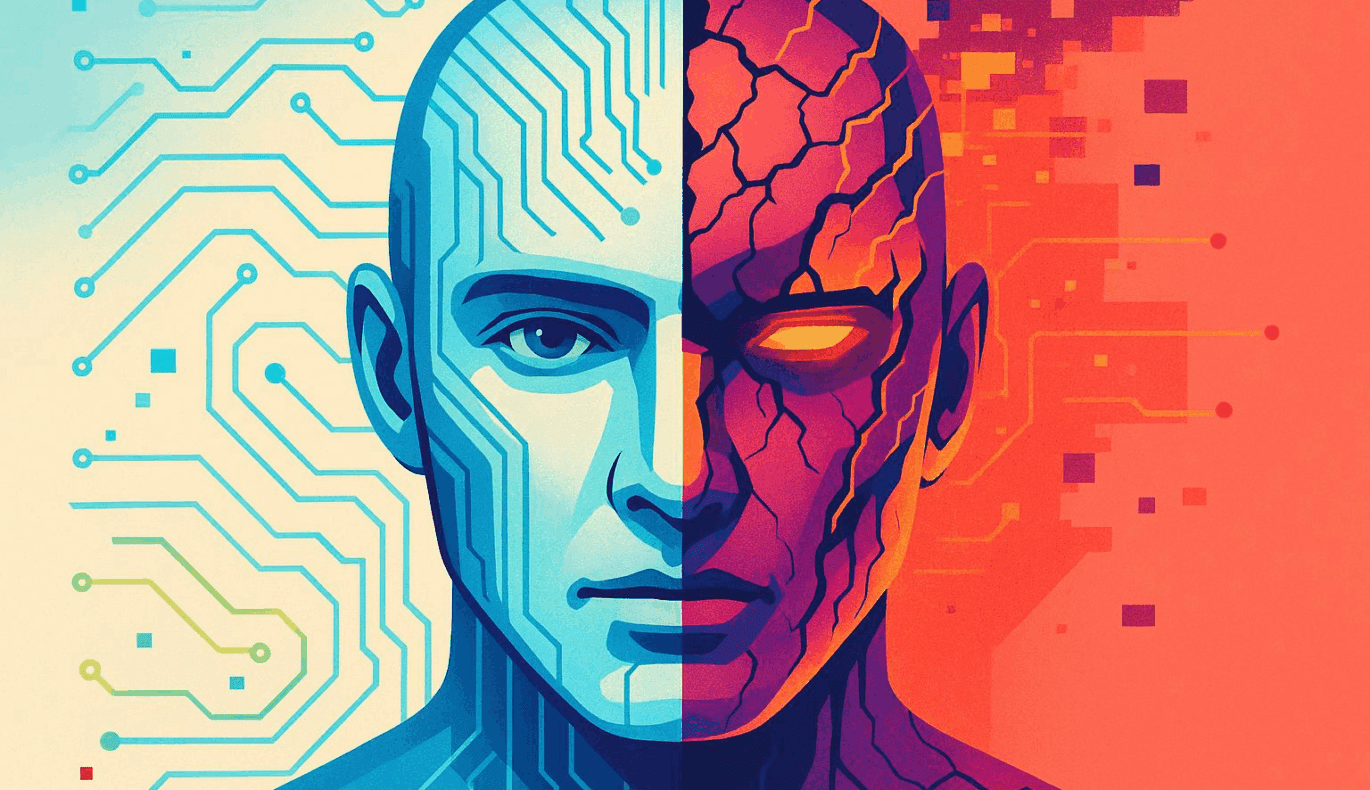
Just like humans, artificial intelligence (AI) can display a peculiar confidence paradox. AI can get stubborn on one hand, and on the other hand, exhibit a tendency to easily abandon its stance when “pressured”. Recent findings from a study conducted by DeepMind, the British AI lab acquired by Google, showcase this unique characteristic in large language models (LLMs). However, the paradoxical nature of AI confidence may have serious implications on the development and applications of AI systems, particularly multi-turn systems.
AI Confidence: A Double-Edged Sword
In the context of AI, confidence can be viewed as the degree of certainty a model shows in its predictions or decisions. AI systems can predict events with a certain level of confidence. However, the interesting aspect of AI confidence lies in the two contrasting traits it often displays: overconfidence and underconfidence.
AI can exhibit overconfidence, also known as stubbornness, when it sticks to its original predictions, completely reluctant to change its stance, even when faced with contradictory evidence. Conversely, AI can also display underconfidence, a trait characterized by the tendency to ditch its original, and often correct predictions under the slightest hint of ‘pressure.’
This confidence paradox presents an intriguing attribute of AI – a characteristic that is both essential but potentially disruptive. But the crucial question is, what does this oddity imply for the future of AI application?
The Impact on Multi-Turn AI Systems
Multi-turn AI systems engage in interactions that span several turns, akin to a human conversation. Such systems rely heavily on the model’s ability to accurately predict and respond to different turns, making the model’s confidence crucial.
The DeepMind study indicates that the paradoxical behavior of AI confidence could pose a threat to the stability and reliability of these systems. For instance, if an overly confident AI model rejects new information in an evolving interaction, it could lead to inaccurate responses. Similarly, an underconfident model that readily abandons its correct predictions could result in erroneous conclusions.
In scenarios where the implications of a decision are significant, the erratic behavior of the AI model could bring about detrimental consequences.
Though the succinctness of the AI conundrum remains perplexing, the efforts by DeepMind and other AI researchers to comprehend and rectify the concerns are already underway. Having gained crucial insights into AI confidence behavior, it is imperative for AI developers to consider this paradox while designing future AI applications. Only then can the full potential of AI be realized, and its risks minimized.
The study is a reminder of the dynamic and evolving nature of AI research. It brings to light the complex characteristics of AI, ones that make it both fascinating and challenging. As we continue to embrace and incorporate AI into our world, understanding all aspects of its behavior becomes not only desirable but also necessary.
For more insights on the study, visit the original article here.