


Description
AI Customer Churn Predictor & Saver centralises billing events, product usage and support activity to produce a clear churn likelihood score and a short explainable reason for each flagged account. The service prioritises at-risk customers, suggests context-aware retention actions and can execute low-effort saves automatically or hand off high-value cases to your team.
Implementi.ai configures, runs and maintains the automation as a managed monthly service: we connect agreed systems, tune thresholds with you, monitor operation and handle updates so your team receives timely, actionable work items without maintaining the workflows.
The problem
Many subscription teams rely on separate dashboards — a billing console for payment failures, an analytics tool for product usage and a helpdesk for support issues. Reviewing these sources manually is slow and inconsistent: teams miss early warning signs, duplicate effort and react only after a customer cancels. As the customer base grows, manual triage becomes unsustainable and noisy alerts divert attention from accounts that genuinely need human outreach.

What this solution automates
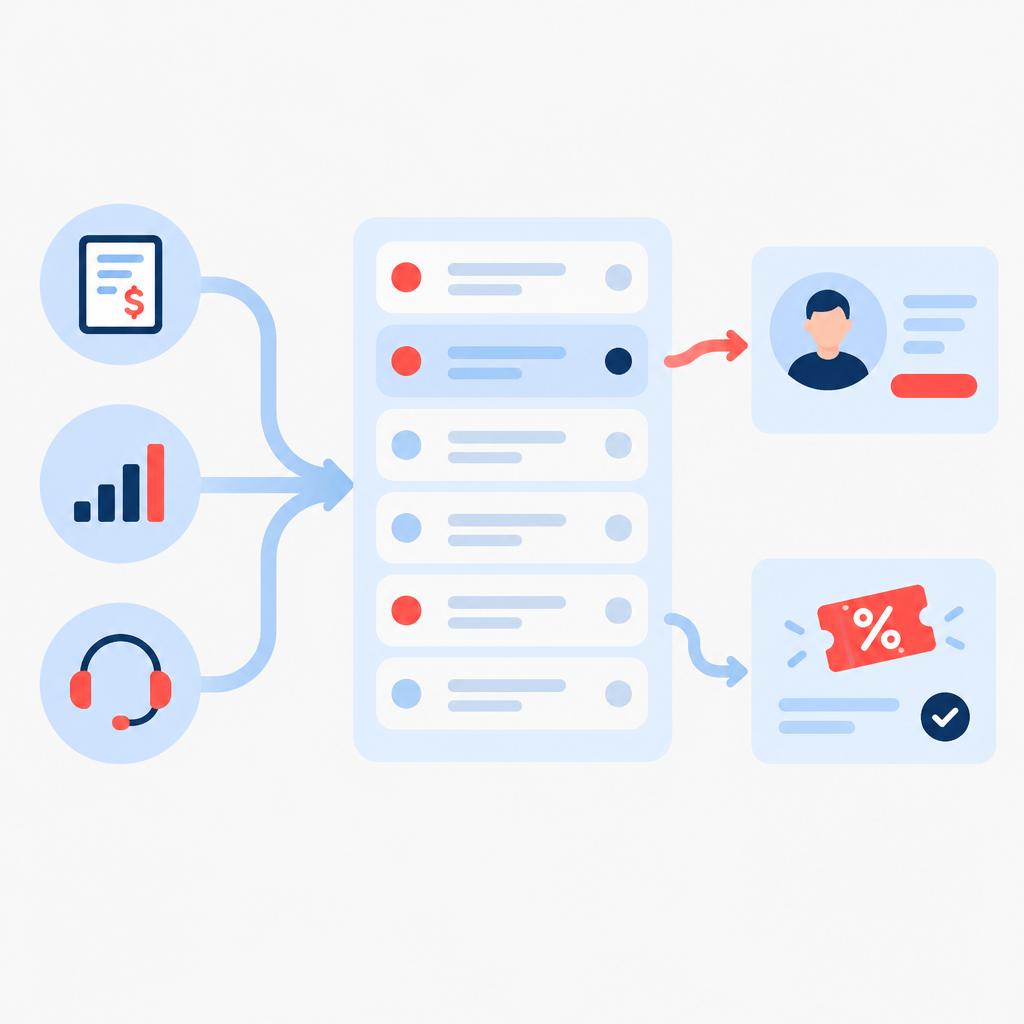
This managed service continuously collects and normalises key retention signals, computes an explainable churn score for each customer, and applies your business rules to decide whether to notify a human, create a CRM task or execute an automated save.
- Ingest billing events (payment failures, plan changes) and usage metrics.
- Analyse recent support conversations and basic sentiment cues.
- Produce a concise churn likelihood score and short natural language explanation.
- Route alerts to Slack, HubSpot or other CRMs and create prefilled tasks.
- Automate simple saves such as coupon issuance or trial extension where authorised.
- Log scores and outcomes for ongoing measurement and tuning.
What your business gains
- Prioritised work. Focus Account Managers on customers with the highest demonstrable risk, reducing wasted manual triage and ensuring attention lands where it matters.
- Faster recoveries. Automate routine saves for common, low-effort cases (failed payment retries, short usage dips) so recoveries happen without manual steps.
- Consistent reasoning. Each alert includes a short, human‑readable explanation of the strongest signals to support faster, more informed outreach.
- Repeatable retention playbooks. Standardised action templates and routing rules make response actions consistent and measurable across the team.
- Operational visibility. Logged scores and outcomes let managers track which interventions work and iterate on thresholds and templates.
A practical use case
For a growing SaaS vendor with monthly subscriptions, churn often begins with a failed card, followed by a brief drop in active usage and one or two frustrated messages to support. Instead of waiting for cancellation, this service flags the account as ‘at risk’, provides a short explanation (e.g., “payment failed + 40% drop in logins”), and either sends an automatic coupon to recover the account or creates a HubSpot task for the assigned CSM with a prefilled outreach script. This reduces emergency retention fire-fighting and helps teams scale a consistent approach to saves.
Who is it for?
- Small-to-mid SaaS vendors — need practical churn detection without a dedicated data science team.
- Subscription service operators — who rely on recurring billing and want predictable retention workflows.
- Customer Success teams — aiming to prioritise outreach and measure the impact of retention tactics.
- RevOps teams — who want an operational layer that integrates billing, CRM and support signals into the revenue operations playbook.
What is included in the monthly service
The monthly subscription covers the implementi.ai managed automation: connections agreed before launch, ongoing AI scoring and explanations, monitoring of the automation’s operation, handling and fixing errors, and routine maintenance and configuration updates needed to keep the agreed solution working.
- Ongoing AI scoring and short explanations for flagged accounts.
- Monitoring and error handling for integrations and routing.
- Periodic threshold or template updates as part of agreed maintenance.
When this solution may not be necessary
- Companies with no recurring billing or product usage data — the product needs event signals to produce meaningful scores.
- Enterprises with large, complex data science teams seeking a bespoke predictive model — they may prefer an in‑house build.
How it works
- Signal collection. The service listens for agreed trigger events from billing, CRM and support systems and optionally ingests lightweight usage metrics into the orchestration layer.
- Feature assembly. Collected events are converted into interpretable indicators (failed payment count, recent usage trend, support sentiment, login frequency) used for scoring.
- Scoring & explanation. An AI-assisted synthesis produces a churn likelihood score and a short human-readable explanation highlighting the strongest signals behind the score.
- Business rules routing. Scores pass through configurable business rules that decide whether to auto-save, create a CRM task, or send an alert to the account owner in Slack.
- Automated actions. Where authorised, the system executes low-effort saves such as issuing a coupon, extending a trial, or triggering an automated email template.
- Human handling for high-value accounts. High-priority accounts are handed to CSMs with a prefilled outreach summary and suggested next steps based on the explanation.
- Logging & feedback. Outcomes are recorded back to your CRM or a lightweight datastore so thresholds and templates can be tuned over time.
Example workflow
For example, imagine a company that bills monthly and uses HubSpot for CRM and Intercom for support. A customer’s card fails, their weekly active users fall by 35% and a recent Intercom conversation shows frustration. The automation ingests those signals, generates a medium-high churn score with a one-paragraph explanation, and routes the case: an automated coupon is offered because the account meets the “low-value, quick-save” rule, while a higher-value account with the same signals would create a HubSpot task for the CSM with a prefilled message. The chosen action and the outcome are logged for later review.
Integrations
Typical systems
Typical systems we connect include billing platforms (for example Stripe), CRM systems (for example HubSpot), customer messaging/support tools (for example Intercom), and lightweight stores or logs such as Google Sheets. The AI scoring step uses an LLM service agreed before launch. Other systems can potentially be connected after compatibility is confirmed.
Connection methods
We use standard API or webhook access where available, native connectors through agreed orchestration layers, and CSV or Google Sheets for lightweight data exchange when an API is not available. Exact methods are confirmed during scoping to ensure secure and reliable access.
What we need from your company
Before launch we agree which systems to connect, example data samples, the events or fields that indicate churn risk, and the set of authorised automated actions. We also need the target CRM fields or Slack channels where alerts and tasks will appear, plus any business rules for routing and approval thresholds. Compatibility and exact access methods are confirmed and agreed before implementation.
FAQ
Which systems can you connect to?
We typically connect to billing platforms (e.g., Stripe), CRMs (e.g., HubSpot), support/messaging tools (e.g., Intercom) and can accept CSV or Google Sheets exports when APIs are unavailable. Exact compatibility is confirmed during scoping.
How customisable are scoring thresholds and actions?
Thresholds, routing rules and action templates are configurable during the onboarding and tuning period. Implementi.ai will adjust these settings as part of the managed service to match your retention playbooks.
Will the system act automatically without human approval?
Automated actions are performed only when authorised in the agreed configuration. You choose which save types can run automatically and which require human approval or a CSM task.
What data is required to produce useful scores?
Useful signals include recent billing events, simple usage metrics (e.g., active sessions), and support conversation snippets or sentiment. If some signals are missing, scoring will rely more on available data such as billing events.
How do we measure whether saves work?
We log scores and outcomes back to your CRM or a lightweight datastore so you can review which interventions recovered an account and iterate on rules and templates accordingly.
How does implementation start?
We begin with a scoping call to agree systems, sample data and routing rules. Access methods and the final scope are confirmed before work begins; launch timing depends on the number and complexity of integrations.
Price
The activation fee covers the initial setup, implementation and launch of the agreed automation scope.
The monthly subscription covers the ongoing operation, maintenance and management of the automation service.
The exact scope and final monthly subscription are confirmed before launch.
Ready to automate this process?
Tell us which billing, CRM and support tools your company currently uses.
We’ll confirm how this solution can be connected, its scope and the final monthly subscription.
| Email uscontact@implementi.ai | Call us+48 660 983 178 |