

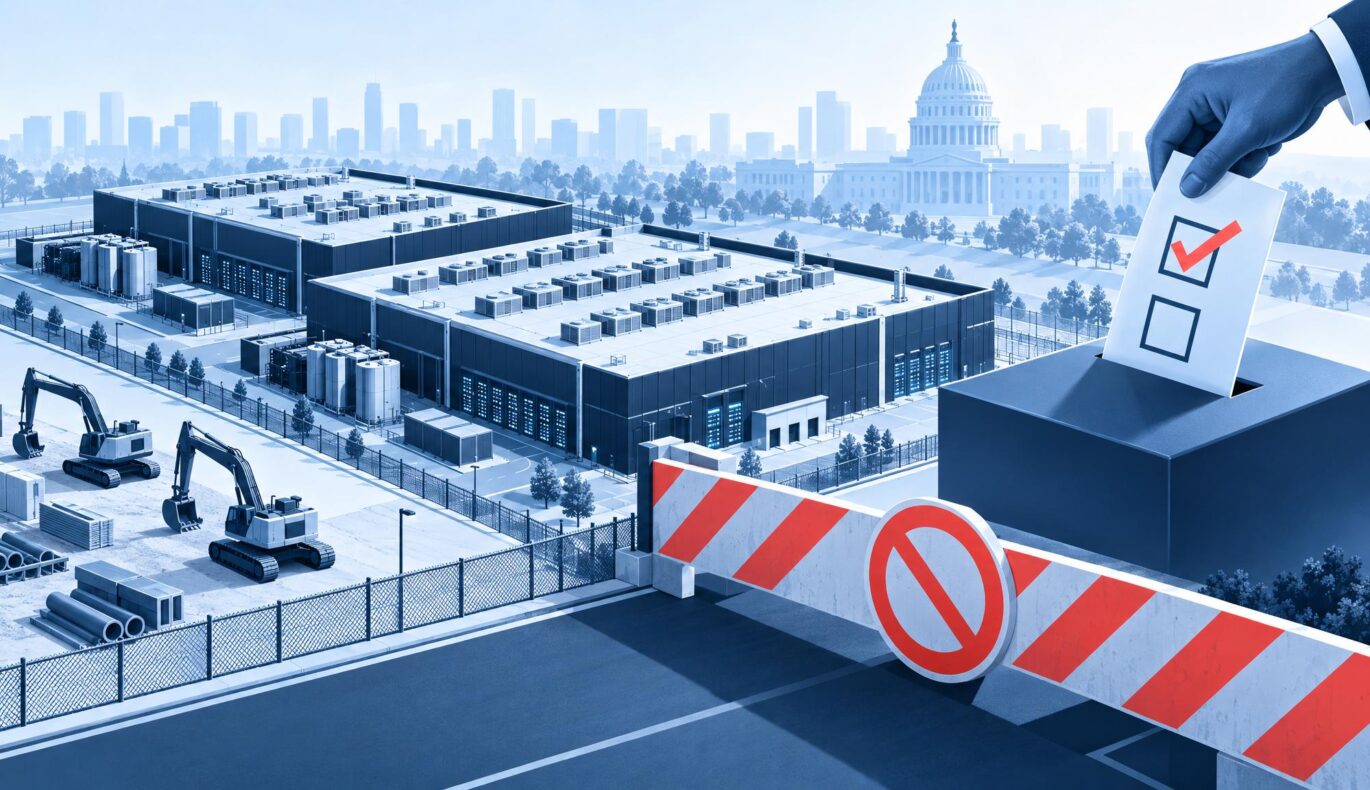
Data-center developers face a tougher political environment after voters in the 2026 US midterms backed candidates and local ballot measures that would restrict new facilities. The result matters to AI companies, cloud providers, utilities and communities because data centers are a foundation of AI infrastructure, but their construction can bring disputes over land, electricity, water and local development.
What “data centers lost the midterms” means
The headline describes a political setback, not the shutdown of existing data centers. According to the reported results, voters in dozens of local communities approved measures that create additional obstacles to data-center development, while candidates who support moratoriums won important races.
An NBC News Election Day poll cited in the report found that 76% of respondents opposed data centers in their communities. The source specifically identifies Texas Democratic governor-elect Gina Hinojosa and Michigan Democratic senator-elect Abdul El-Sayed as winners who support development moratoriums.
The available material does not establish a single nationwide ban, a uniform set of rules, or the precise terms and legal status of the local measures. It also does not say how many planned projects will be delayed, cancelled or moved. “Lost the midterms” should therefore be read as a description of the election’s direction of travel for developers, rather than a quantified industry impact.
Why the result matters for AI and cloud infrastructure
New data centers require local approval and physical infrastructure, so a more restrictive building environment can make expansion less predictable. For AI companies and cloud operators, the immediate issue is not a newly announced product or feature; it is whether planned computing capacity can be built where and when it is needed.
For local governments, the vote signals that community acceptance is becoming a central condition of infrastructure planning. The source material does not provide detailed findings on privacy, cybersecurity, energy performance or water consumption, so it would be premature to claim that any particular technical safeguard drove the results.
Implementi.ai analysis: what teams should watch
Businesses planning AI workloads should treat physical capacity and location as planning risks alongside model costs and software availability. Teams may need to ask cloud suppliers how dependent a service is on new construction, whether capacity can be shifted between regions, and what uncertainty exists around infrastructure timelines—questions the reported election results make more urgent, but do not answer.
For example, an SME preparing a large document-processing deployment might hypothetically phase its rollout and retain more than one hosting option while local approvals remain uncertain. That would not eliminate capacity or cost risks, and the source provides no evidence that such arrangements are currently offered or required.
The practical next step is to monitor the exact language, implementation and legal challenges associated with each local measure rather than treating the election as a blanket national policy change. Until those details emerge, developers and AI users have a political warning, not a complete forecast of data-center availability.
Fuente: Reportaje original. Este artículo incluye un contexto editorial independiente y un análisis práctico.
Más información sobre la IA: Echa un vistazo a nuestra Últimos artículos sobre automatización y tecnología de IA, o echa un vistazo a soluciones de automatización listas para usar.