
Description
The AI Shipping Damage Claim Manager automates detection, documentation and routing for possible damaged shipments. It continuously monitors order, delivery and returns feeds plus inbound customer messages and images to identify incidents that should be escalated as carrier claims or internal refunds.
implementi.ai configures the connectors, runs the AI models to classify damage risk and compiles the standardised claim packets. As an ongoing managed service we operate, monitor and maintain the automation, handle error fixes and update rules so the solution continues to surface recoverable incidents and reduce manual overhead.
Le problème
When damage occurs in transit the information needed to start a carrier claim is often scattered: order records in an e-commerce platform, tracking events from the carrier, photos sent by customers, warehouse inspection notes and email threads. Teams typically assemble this information manually, create inconsistent claim documents, miss carrier time windows, and escalate only after customer complaints. As shipping volumes grow the problem becomes harder: more exceptions, more photos to review, slower responses and more lost recovery opportunities.

Ce que cette solution automatise
This service automates detection, documentation and routing for likely shipping damage incidents and supports the operational workflow from detection to claim submission and customer communication.
- Continuously monitor orders, tracking events, returns and support messages for damage indicators.
- Use AI to classify severity, extract relevant fields (order number, tracking ID, damage description) and validate required evidence.
- Assemble standardised claim packets (text summary, timestamps, photos, shipment metadata) ready for carrier submission or internal processing.
- Route claim packets to the correct party — carrier claims API, returns team, finance for refunds or repair partners — according to agreed rules.
- Create internal task notifications and update CRM/order records with claim status and links to evidence.
- Flag exceptions requiring human review when evidence is incomplete or disputed.
Les avantages pour votre entreprise
- Faster recovery. Automating detection and packet assembly reduces the time between incident and claim submission, improving the chance of carrier reimbursement and avoiding long manual search across systems.
- Consistent documentation. Standardised claim packets ensure every submission contains the required fields and evidence, reducing rework and rejected claims.
- Lower operations load. The automation handles routine classification and routing so support and returns teams spend less time assembling cases and more time resolving complex disputes.
- Une expérience client améliorée. Customers receive timely, consistent updates about next steps and expected outcomes while issues are routed efficiently to the right team.
- Audit trail and visibility. The solution maintains an accessible history of incidents, actions and outcomes so finance and operations can review recovery performance and trends.
Un cas d'utilisation concret
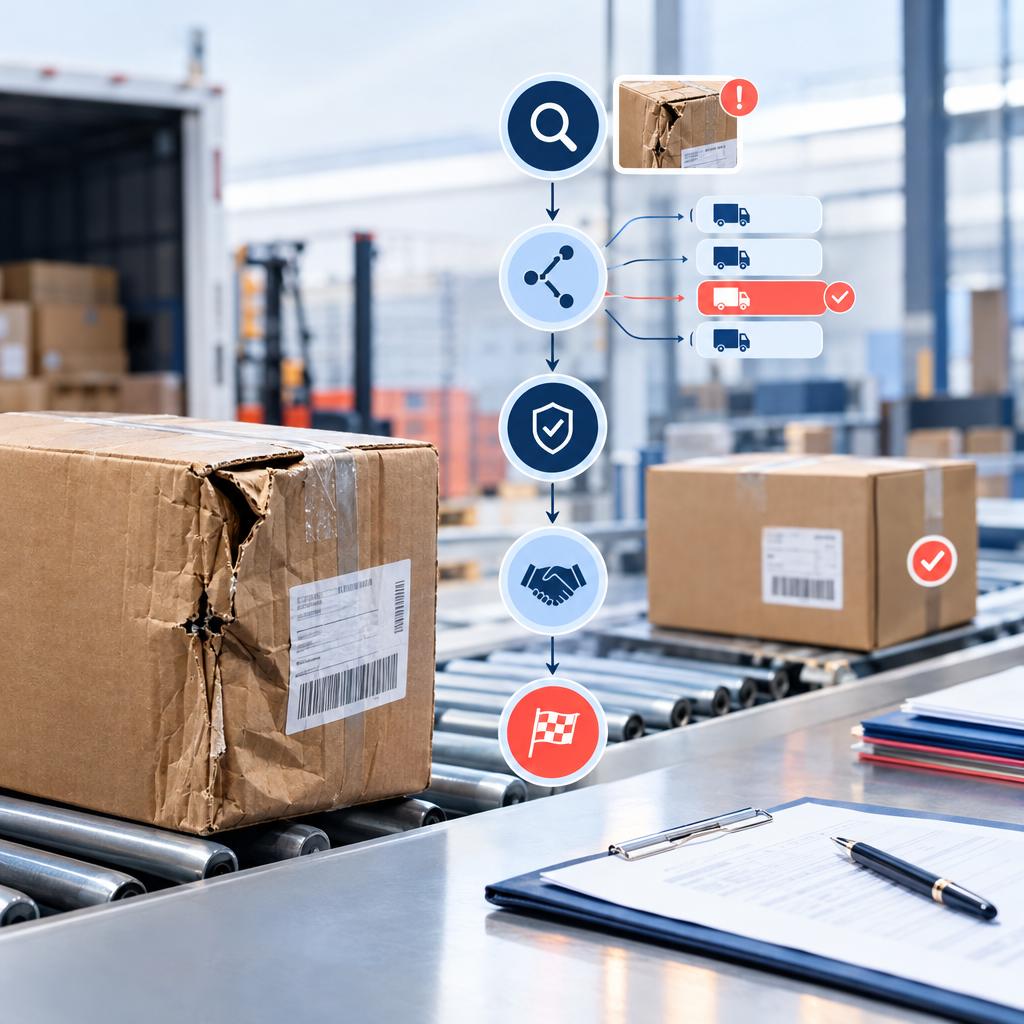
A mid-sized online retailer ships thousands of parcels weekly via several carriers. Customer support receives photos and complaints about damaged goods, but agents must manually collect tracking events, warehouse inspection notes and order metadata before filing a carrier claim. Backlogs grow and many claims are submitted late or missing key photos. With the AI Shipping Damage Claim Manager the retailer continuously detects probable damage incidents from returns and inbound messages, auto-generates a complete claim packet (order, tracking, photos, inspection notes) and routes it either to the carrier API or to a human reviewer if evidence is incomplete. This reduces manual assembly work, shortens decision cycles and increases the consistency of claim submissions while keeping customers informed throughout the process.
À qui s'adresse-t-il ?
- Online retailers with medium to high parcel volume — need to scale claims handling without growing headcount.
- Third‑party logistics providers and warehouses — require a standardised way to capture inspection evidence and escalate claims to carriers or clients.
- Customer service teams that handle returns and damage complaints — benefit from faster case resolution and consistent communication.
- Finance teams managing carrier recoveries — get cleaner, auditable claim packets to support reimbursement workflows.
Qu'est-ce qui est inclus dans l'abonnement mensuel ?
The monthly subscription covers the fully operated automation and ongoing maintenance required to keep the solution working in production.
- Connections with agreed systems and continuous AI processing to detect and classify damage incidents.
- Monitoring of the automation’s operation and handling/fixing integration or classification errors as they arise.
- Maintenance and reasonable configuration updates to keep routing rules, carrier templates and evidence requirements current.
- Ongoing support to adjust thresholds, add new carriers or update claim packet formats as required (scope agreed before launch).
Dans quels cas cette solution n'est-elle pas nécessaire ?
- Organisations with extremely low shipping volume where manual handling is already efficient and inexpensive.
- Companies that require specialised forensic damage inspections or legal proof beyond photographic and metadata evidence; those still need dedicated inspection workflows.
Comment ça marche
- Approvisionnement continu. The service continuously ingests order, shipment tracking, returns and inbound customer messages from the systems you agree before launch, normalising them into a single event stream for review.
- Classification par IA. Natural language and image models analyse messages, return notes and photos to detect likely damage incidents and estimate whether available evidence meets carrier requirements.
- Evidence assembly. For flagged incidents the automation compiles a standard claim packet: order metadata, tracking timeline, photos, inspection notes and a concise incident summary suitable for carrier submission or internal review.
- Routing decision. Configured rules determine whether the packet is auto-submitted to a carrier claims endpoint, routed to finance for refund processing, sent to a returns/repair queue or escalated to a human reviewer when information is missing.
- Notification & record updates. The system updates order and CRM records with claim status, creates task notifications for responsible teams and sends templated customer updates where agreed.
- Human review & completion. When exceptions occur, the assigned reviewer sees the compiled packet and decision history, can add notes or additional evidence, and approve or reject submission. The automation logs the outcome and continues monitoring for carrier responses.
Exemple de flux de travail
For example, imagine a company that ships consumer electronics and receives a customer photo showing a cracked screen plus an email complaint. The automation detects the complaint via the support inbox and matches it to the original order and tracking events. An image model classifies the photo as likely transit damage and extracts timestamps; the system assembles the claim packet (order number, tracking history, photo, warehouse inspection note) and checks the carrier’s evidence checklist. Because the packet meets the configured threshold, the system automatically submits a structured claim to the carrier API and updates the order status and CRM with a claim reference. If the evidence had been insufficient, the incident would have been routed to a returns inspector with a task and pre-filled checklist for quick human completion.
Intégrations
Systèmes types
Typical systems we connect to include e-commerce platforms (Shopify, WooCommerce, Magento), warehouse management or fulfilment systems, carrier platforms and tracking feeds (DHL, UPS, DPD, other carrier APIs), returns and RMA systems, CRM or helpdesk platforms (Zendesk, Freshdesk) and accounting or finance systems for recovery tracking. These are examples — final compatibility is confirmed before launch and can include other platforms accessible via API, webhook, email or file export.
Méthodes de connexion
Connections can be implemented using platform APIs or webhooks for real‑time events, scheduled CSV or SFTP exports for shipment and returns logs, email ingestion for customer attachments and Google Sheets where needed for interim data exchange. Carrier claim submission may use carrier APIs or templated emails, depending on the carrier’s available interface. The chosen methods are agreed during scoping.
Ce que nous attendons de votre entreprise
Before launch we agree which systems will be connected, sample data access (order exports, tracking feeds, returns records and support messages), the mapping between your order/sku identifiers and shipment records, carrier claim rules/templates and your routing/approval rules for refunds, repairs and claim submission. We also need typical examples of damage evidence you accept and any documentation formats required by your carriers. Compatibility and exact access methods are confirmed before implementation.
FAQ
Which carriers and platforms can you connect to?
We commonly integrate with major e-commerce platforms, WMS/fulfilment systems and carrier APIs. Final confirmation of each carrier or platform is made during scoping; where a direct API is not available we can use templated email submission or file-based exchanges.
How do you handle customer photos and privacy?
Photos are processed only to extract relevant evidence for the claim packet and stored within the agreed systems for the duration required by your workflows. Exact handling, retention and access levels are agreed before launch as part of the implementation scope.
Will the system submit claims automatically or require human approval?
Routing rules are configurable. You can choose fully automated submission for claim packets that meet evidence thresholds, or require human approval for all submissions. implementi.ai implements and maintains these rules as part of the managed service.
What happens when required evidence is missing?
The automation flags incomplete cases and routes them to the appropriate reviewer with a pre-filled checklist and tasks to request missing information from warehouse staff or the customer. This keeps human work focused on exceptions rather than routine assembly.
How does onboarding start and how long does it take?
Launch time depends on the number of integrations, access to sample data, carrier interfaces and agreed rules. We confirm the project scope, required systems and timeline before implementation; we do not promise fixed durations without scoping.
Prix
Les frais d'activation couvrent la configuration initiale, la mise en œuvre et le lancement du périmètre d'automatisation convenu.
L'abonnement mensuel couvre l'exploitation, la maintenance et la gestion courantes du service d'automatisation.
L'étendue exacte de l'offre et le montant définitif de l'abonnement mensuel sont confirmés avant le lancement.
Prêt à automatiser ce processus ?
Tell us which e-commerce platforms, carrier partners and returns/CRM systems your company currently uses.
Nous vous confirmerons les modalités de mise en place de cette solution, son champ d'application et le montant final de l'abonnement mensuel.
Réservez un appel de 30 minutes
| Envoyez-nous un e-mailcontact@implementi.ai | Appelez-nous+48 660 983 178 |