


描述
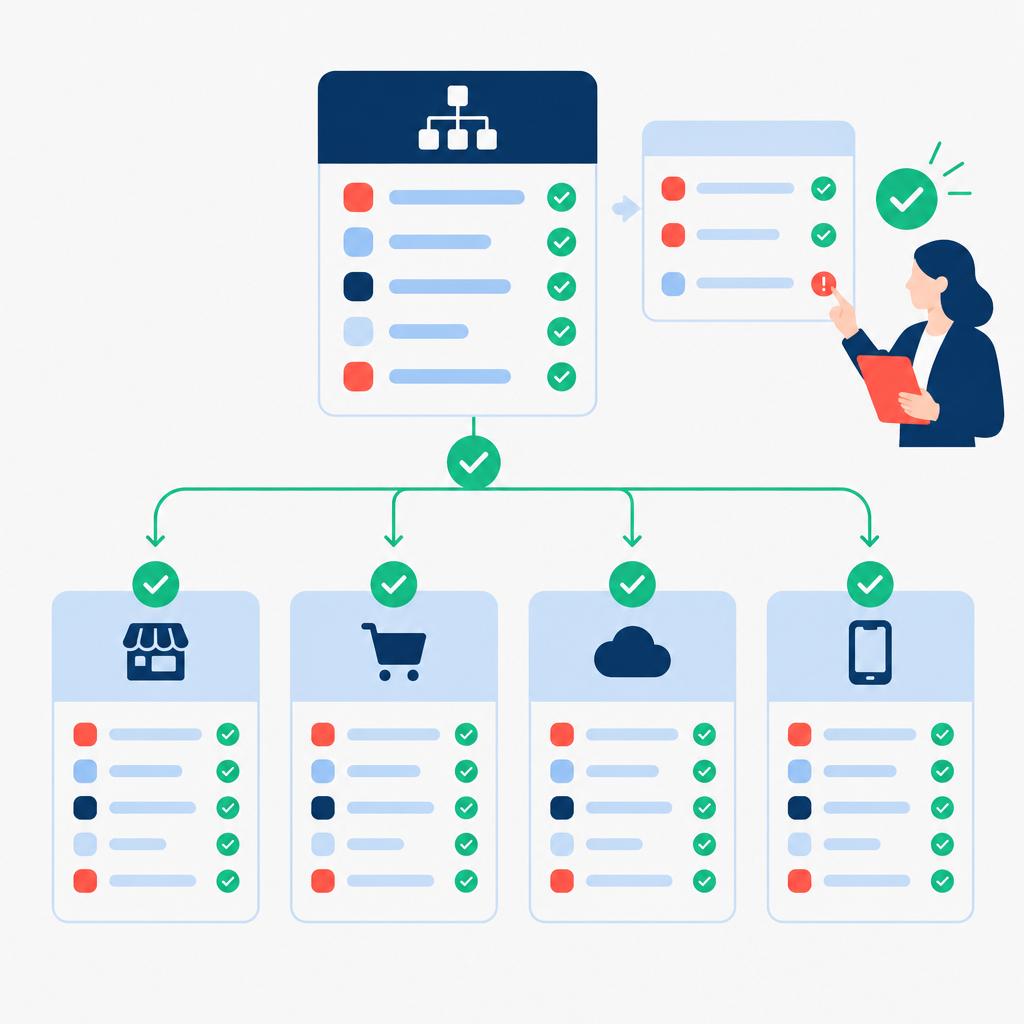
This managed service automatically classifies and normalises product categories, attributes and channel-specific fields so your catalogue appears consistently across webstore, marketplaces and PIMs. It uses AI to infer best-fit categories and attribute mappings, then applies agreed rules or creates suggested mappings for review.
implementi.ai operates and monitors the automation on your behalf: we configure the mapping rules, connect agreed systems, run continuous checks, apply approved updates and handle exceptions and fixes as part of the monthly service.
问题
Most companies rely on manual spreadsheets and ad-hoc rules to keep product categories and attributes consistent. As SKU counts grow and products are listed on multiple marketplaces, small inconsistencies cascade into poor search relevance, rejected listings, mismatched attributes and higher manual workload for catalogue teams. Each sales channel has its own taxonomy and required fields; maintaining separate mappings and keeping them in sync is time-consuming and error-prone without an automated approach.

该解决方案实现了哪些自动化功能
This product continuously inspects your product data, suggests and applies category and attribute mappings, and keeps channel-specific fields in sync according to agreed rules. It focuses on classification, normalisation and safe automated updates rather than full catalogue re-design.
- AI classification of product titles, descriptions and attributes into a master taxonomy.
- Generation of channel-specific attribute mappings and required-field checks.
- Automated feed updates to connected platforms (apply or staged for approval).
- Exception detection and prioritised review queues for ambiguous SKUs.
- Ongoing monitoring and corrective actions when mappings drift or new SKUs appear.
您的企业将获得什么
- Consistent listings across channels. Ensures the same category and attribute logic is applied to each SKU across webstore, marketplaces and PIMs so customers find products and listings meet channel requirements.
- Reduced manual catalogue work. Automates the repetitive classification and mapping tasks, freeing merchandisers to focus on exceptions and strategic updates rather than bulk corrections.
- Fewer listing rejections and errors. Pre-validates channel-specific required fields and flags missing or non-compliant attributes before feeds are published.
- Faster onboarding of new SKUs. New products are auto-classified and routed for review only when ambiguity exists, reducing time-to-list.
- Auditable mapping history. Maintains a record of mapping decisions and changes so reviewers can trace why an SKU was categorised or updated.
一个实际应用案例
Imagine a mid-size retailer selling across its Shopify store, a branded web catalogue and two marketplaces. Product titles and attribute sets were created over years by different teams, so the same shoes appear under multiple categories and some items lack size or material attributes required by marketplaces. The AI Product Taxonomy Mapper scans catalog records, proposes consistent master categories, converts attributes into each channel’s required fields, and updates feeds. Merchandisers review only exceptions and confirm suggested mappings, while routine items are normalised automatically. This reduces listing errors and the manual time spent normalising new arrivals.
为谁而设?
- Multi-channel merchants with 1,000+ SKUs — need continuous taxonomy maintenance without growing headcount.
- Marketplaces sellers listing on Amazon, eBay and others — require channel-specific attribute compliance to avoid suppressions.
- PIM or catalogue managers — want to offload repetitive classification and maintain a single source of truth.
- Retail operations teams — need reliable feeds to downstream systems (ERP, analytics) and fewer data quality incidents.
月度服务包含哪些内容
The monthly subscription covers the managed automation and ongoing operations required to keep your product taxonomy aligned across agreed systems. implementi.ai configures mappings, connects the agreed platforms, monitors operation, fixes integration errors and performs reasonable configuration updates to keep the solution working as your catalogue changes.
- Operation and monitoring of the automation.
- 与系统之间的连接已在上线前达成一致。.
- AI classification and mapping where required.
- Handling and fixing automation errors.
- Maintenance and reasonable configuration updates.
何时可能不需要此解决方案
- Very small catalogues (<100 SKUs) with no multi-channel requirements — manual classification may be sufficient.
- Businesses needing a full catalogue re-design or brand taxonomy overhaul rather than ongoing normalisation; this service focuses on continuous maintenance rather than a one-off schema redesign.
工作原理
- Initial data audit. We inspect a representative sample of your product records, feeds and marketplace listings to understand taxonomy gaps, attribute variance and channel requirements.
- Master taxonomy definition. Together we agree a master category and attribute model or map to an existing PIM taxonomy; this becomes the baseline for automated classification and mapping.
- AI training and mapping rules. AI models are tuned on your catalogue to generate suggested category assignments and attribute mappings; deterministic rules handle obvious matches while AI covers ambiguous cases.
- Staged updates and approvals. For the first run, suggested mappings are staged for review in a prioritised queue; approved mappings are applied and logged. Rules are tightened based on reviewer feedback.
- Ongoing sync and monitoring. The service runs scheduled syncs to detect new or changed SKUs, applies safe mappings, updates connected platforms and monitors for feed errors or channel rejections.
- Exception routing and human review. Ambiguous or high-impact SKUs are routed to your product team with context and suggestions; implementi.ai handles repeat fixes and rule adjustments.
- Continuous improvement. We maintain mapping history, tune AI models and update configuration as channels change or new marketplaces are added.
工作流示例
For example, imagine a company that sells apparel on its webstore and two marketplaces. A new jacket SKU arrives with a terse title and inconsistent attribute names. The automation extracts title and description text, enriches missing attributes from similar SKUs, and the AI classifier assigns it to the “Outerwear > Jackets” master category. Channel-specific mappings populate size, material and GTIN fields required by Marketplace A and a different attribute set for Marketplace B. The system flags one missing required field and creates a low-priority exception for review; once corrected, the feeds are updated and the SKU goes live without manual bulk edits.
集成
典型系统
Typical systems that can be connected include e‑commerce platforms (Shopify, WooCommerce, BigCommerce, Magento), marketplaces (Amazon Seller Central, eBay, Google Merchant Center), PIMs or catalogue systems (Salsify, Akeneo or similar), and ERPs or inventory systems that provide SKU metadata. Other systems can potentially be connected by agreement.
连接方法
Connections are typically made via platform APIs or native integrations where available. Where APIs are not available we can work with regular CSV feeds, SFTP exchanges, webhooks or Google Sheets exports agreed during onboarding. Exact connection methods are confirmed before launch based on your systems.
我们希望贵公司能提供以下内容
Before launch we agree the systems to connect, provide sample product exports or API credentials for the agreed platforms, and define the master taxonomy and approval rules. We also need a list of high-priority SKUs or channel rules, and a contact for product-team reviews. Compatibility and exact access methods are confirmed during scoping and before implementation.
常见问题解答
可以连接哪些平台?
We commonly connect to major e‑commerce platforms, marketplaces and PIMs via APIs. If a platform lacks an API we can usually work with scheduled CSV or SFTP feeds. Exact compatibility is confirmed during onboarding.
How much custom configuration is required?
Some configuration is always required: defining the master taxonomy, approval rules and channel mappings. The amount depends on SKU variety and existing data quality; implementi.ai handles configuration updates as part of the monthly service.
Will the system overwrite my listings automatically?
By default we stage suggested mappings for approval on first runs. After a governance level is agreed, routine matches can be auto-applied while ambiguous or high-impact changes remain manual. The approval approach is configured before launch.
异常是如何处理的?
Ambiguous SKUs are routed into a prioritised review queue with suggested mappings and context. implementi.ai monitors exceptions, applies fixes where agreed, and adjusts rules to reduce repeat exceptions over time.
是什么因素影响了月度价格?
Pricing reflects the number of connected systems, the SKU volume to be processed, frequency of syncs and the amount of per-catalog customisation required. We confirm the final tier after scoping your specific catalogue and integration needs.
我们该如何开始实施?
We begin with an initial scoping call to identify systems, sample exports and success criteria. The launch plan, connection methods and mapping rules are agreed before implementation begins.
价格
激活费涵盖商定的自动化范围的初始配置、实施和上线工作。.
月度订阅费用涵盖了自动化服务的日常运行、维护和管理。.
具体范围和最终的月费将在上线前确定。.
准备好将此流程自动化了吗?
Tell us which e‑commerce platforms, PIMs and marketplaces you use and an approximate SKU count.
我们将确认该解决方案的接入方式、适用范围以及最终的月度订阅费用。.
| 给我们发电子邮件contact@implementi.ai | 请致电我们+48 660 983 178 |