


Description
The AI Cart Abandonment Rescue & Offer Sequencer monitors cart abandonment events, classifies intent and runs managed, personalised recovery sequences across email and SMS. implementi.ai configures the rules and sequences, keeps the automation running and optimises messaging over time.
This managed service removes the recurring manual work of drafting one-off reminders, choosing who gets offers and correlating responses back into your CRM and order systems. We operate and maintain the automation, handle errors and update sequences as your offers and channels change.
The problem
Without automation, cart recovery is a mix of scheduled generic emails and ad‑hoc manual outreach. Marketing teams spend time creating templates, deciding when to apply discounts, and tracking who already received a sequence. As volumes grow this becomes error‑prone: duplicate messages, inconsistent discounts, missed follow‑ups and fragmented CRM records. The work multiplies when stores sell across platforms, use multiple messaging providers, or need to coordinate offers with inventory and fulfilment rules.

What this solution automates
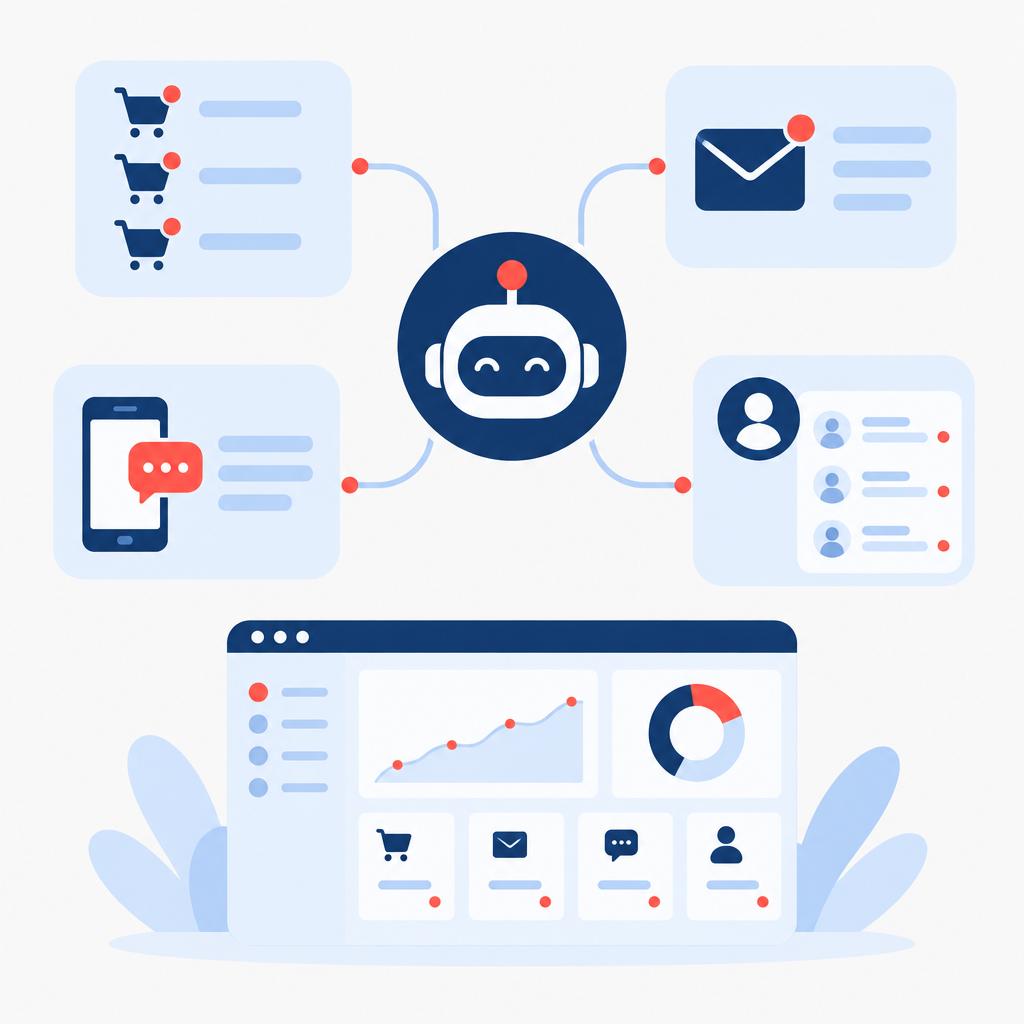
This product automates detection, analysis and managed follow-up for cart abandonment events and sequences the right communications based on shopper signals and business rules.
- Detect abandoned carts and capture relevant context (items, value, customer identity, channel).
- AI‑classify abandonment intent and recommend message tone and timing.
- Trigger personalised email and SMS sequences with optional time‑limited offers.
- Update CRM and order systems with engagement outcomes and recovery status.
- Pause or alter sequences for inventory or fraud flags, and surface exceptions for human review.
- Monitor performance and apply sequence tweaks as part of the managed service.
What your business gains
- Recovered revenue opportunities. Automated, timely and personalised outreach improves the chance a shopper returns to complete an order without manual follow-up.
- Consistent offer governance. Rules manage who receives discounts, preventing overuse of coupons and keeping margin control in one place.
- Reduced manual workload. Marketing and support teams spend less time drafting messages, checking which customers already received offers and reconciling results.
- Integrated customer data. Engagement outcomes are recorded in CRM and order systems so your teams see a single customer timeline for follow-up and reporting.
- Continuous optimisation. implementi.ai monitors sequence performance and applies configuration updates to improve results over time.
A practical use case
A mid-sized online retailer selling footwear runs regular promotions and sees many customers add high-value items to carts but not complete checkout. The marketing team wants targeted recovery but cannot manually personalise at scale or coordinate discount rules across platforms. Implementi.ai connects the shop, email provider and CRM, then runs an automated sequence that identifies high-intent abandons, sends a personalised reminder followed by a targeted offer only when appropriate, and logs the result back to the CRM for sales and support teams to act on. Exceptions—like out-of-stock items—are paused and routed for human handling.
Who is it for?
- Small-to-mid online retailers (Shopify, WooCommerce, BigCommerce): need scalable cart recovery without building orchestration in-house.
- Marketing teams with limited automation resources: want personalised sequences and offer governance managed for them.
- Brands selling mid-to-high average order value items: prioritise selective offers and CRM updates for high-value carts.
- Merchants using multiple messaging channels (email + SMS): want consistent cross-channel sequencing and unified engagement records.
What is included in the monthly service
The monthly subscription covers the ongoing operation and maintenance of the cart recovery automation. implementi.ai configures connections, runs the AI classification and messaging orchestration, monitors operation and fixes automation errors as they occur.
- Managed sequence tuning and configuration updates to keep the agreed solution working.
- Monitoring of the automation’s operation and handling of integration errors.
- AI processing for message personalisation and intent classification.
When this solution may not be necessary
- Very low-volume stores with fewer than a handful of monthly abandonments — manual follow-up may be sufficient.
- Businesses that require in-house or regulatory approval for every customer message before sending.
How it works
- Abandonment detection. The automation listens for cart abandonment events from your e‑commerce platform or receives exported cart snapshots and flags candidates for recovery.
- Context capture. For each event we collect cart contents, order value, customer identity (if present), channel history and any inventory or fraud indicators that affect follow-up eligibility.
- AI intent classification. An AI model evaluates the abandon event to estimate intent (browse, price hesitation, checkout friction) and recommends a recovery path: reminder only, personalised incentive, or manual review.
- Sequence selection and orchestration. The system chooses a preconfigured sequence based on intent and customer profile, then schedules messages across email and SMS with appropriate timing and offer rules.
- Message personalisation. AI generates subject lines and message variants tailored to cart contents and customer signals; the chosen ESP/SMS gateway sends the message.
- Outcome capture and CRM sync. Opens, clicks and conversion events are recorded; recovered orders and failed attempts are synced back to your CRM and order system for reporting and follow-up.
- Exception handling and optimisation. Cases that violate inventory, fraud or discount rules are paused and surfaced to a human for action; sequence performance is monitored and updated as part of the managed service.
Example workflow
For example, imagine a company that sells home appliances and notices a spike in carts abandoned at checkout. A shopper adds a washing machine to cart but leaves without paying. The automation captures the cart event, reads past purchase history and real‑time stock status, and AI classifies the abandon as “price hesitation.” The system chooses a two-step recovery: a personalised reminder email within two hours and, if still inactive after 48 hours, a limited-time shipping discount via SMS. If inventory drops below the safety threshold the sequence is paused and a notification is sent to the operations team. The final outcome—conversion or no response—is logged to CRM so customer success can follow up if needed.
Integrations
Typical systems
Typical systems may include e‑commerce platforms such as Shopify, WooCommerce, BigCommerce or Magento; ESPs and marketing platforms like Klaviyo, Mailchimp or Omnisend; SMS providers such as Twilio; and CRMs like Salesforce or HubSpot. Custom carts, order management systems and fulfilment or inventory services can also be connected where APIs or data exports are available. Specific compatibility is confirmed during scoping.
Connection methods
We connect using available APIs and webhooks where possible, or via native integrations provided by your ESP/commerce platform. Where APIs are unavailable we can use secure CSV/data exports, Google Sheets connectors or agreed database access. The exact connection method is agreed before launch and depends on the systems you use.
What we need from your company
Before launch we agree the e‑commerce platform, your ESP/SMS providers, and the CRM or order system to update. We need access methods (API keys or export paths), sample cart and order data, definitions for discount/offer rules, and any approval rules for messages. We also confirm which events should trigger sequences and how inventory or fraud flags should suspend outreach. Compatibility and exact access methods are confirmed during the implementation phase.
FAQ
Which e‑commerce and messaging platforms do you support?
We commonly integrate with Shopify, WooCommerce, BigCommerce and popular ESPs and SMS providers, as well as CRMs. Exact platform compatibility is confirmed during scoping and depends on available APIs or export methods.
How much customisation is possible for sequences and offers?
Sequences, timing, message templates and offer eligibility are configurable. Implementi.ai applies and maintains the agreed configuration and can update sequences as your campaigns or rules change.
Will the system send discounts automatically?
Discount and offer rules are implemented only after you approve governance settings. The automation enforces the rules you define to prevent unintended coupon overuse or margin erosion.
How are exceptions handled—out of stock or suspected fraud?
Inventory and fraud indicators can pause or cancel sequences. Exceptions are routed for human review and the automation logs the reason; implementi.ai monitors and fixes integration errors as part of the service.
What drives the monthly price?
Pricing reflects the number of integrations, event frequency, AI personalisation needs and the level of ongoing monitoring and sequence optimisation required. We confirm final tier before implementation.
Price
The activation fee covers the initial setup, implementation and launch of the agreed automation scope.
The monthly subscription covers the ongoing operation, maintenance and management of the automation service.
The exact scope and final monthly subscription are confirmed before launch.
Ready to automate this process?
Tell us which e‑commerce platform, email/SMS providers and average monthly cart abandonment volume you currently have.
We’ll confirm how this solution can be connected, its scope and the final monthly subscription.
| Email uscontact@implementi.ai | Call us+48 660 983 178 |