

Description
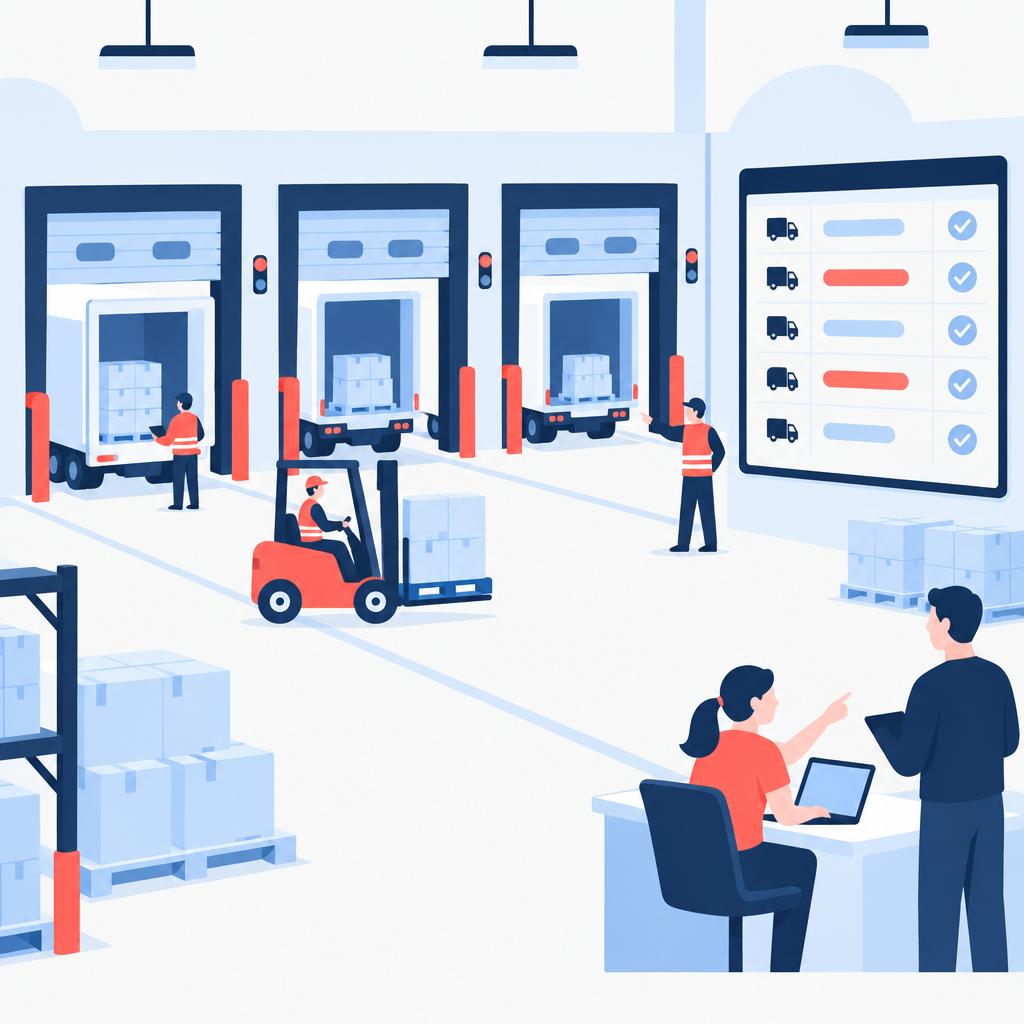
This managed service automatically turns incoming shipment notices and carrier ETAs into scheduled dock appointments, then updates your WMS/ERP and notifies operations staff. When timings change or exceptions appear, the system classifies the issue, reroutes notifications and triggers predefined recovery actions so teams can focus on receiving rather than firefighting.
implementi.ai configures, operates and maintains the automation for you: we set up the data connections, keep the ETA models and routing rules tuned, monitor day-to-day operation and handle automation errors as part of the monthly service.
The problem
Most mid-size and larger warehouses rely on a mix of phone calls, emails and spreadsheets to schedule inbound trucks. Carriers publish ETAs in different formats and timezones, suppliers change load priorities or expected quantities, and receiving teams manually negotiate dock slots. As inbound volumes grow, this ad-hoc process causes dock congestion, extended unloading times, missed delivery promises and reactive labour reallocation. The lack of a continuous, consolidated view of ETAs and slot capacity makes it hard to run predictable receiving operations at scale.

What this solution automates
This product automates ETA normalisation, slot assignment, exception detection and notification routing across your inbound pipeline. It can prioritise critical loads, automatically update receiving slots in connected systems and start recovery workflows for late or incomplete shipments.
- Normalise ETAs from carriers, supplier notices and EDI/ASN feeds into a single timeline.
- Automatically allocate dock slots based on capacity, priority and resource constraints.
- Post confirmed appointments to WMS/ERP and calendar systems.
- Detect exceptions (ETA drift, missing ASN, over/under quantity) and route them to the right team or queue.
- Trigger follow-up actions such as supplier alerts, carrier rebooking suggestions or temporary labour requests.
- Maintain a history of inbound events and ETA accuracy for ongoing tuning.
What your business gains
- Predictable receiving. Reduce last-minute rework by turning disparate ETA signals into confirmed dock appointments so operations can plan labour and equipment in advance.
- Faster exception handling. The system routes the right exception to the right team with context, reducing time spent chasing information across email and phone.
- Lower dock congestion. Automated slotting and re-slotting prevents overlapping appointments and smooths arrival patterns to improve throughput.
- System-of-record updates. Confirmed appointments and changes are written back to WMS/ERP and calendar systems to reduce duplicate data entry and confusion.
- Ongoing operational support. implementi.ai runs, monitors and updates the automation so your IT and operations teams don’t manage daily tuning and error handling.

A practical use case
A regional distributor receives hundreds of inbound shipments daily from a mix of carriers and suppliers. Receiving managers spend mornings recalculating dock capacity after a wave of late arrivals, and warehouse supervisors run overtime to clear backlogs. With the AI Inbound Dock Scheduler, carrier ETAs and ASN feeds are consolidated and slotting rules automatically allocate appointments according to dock availability and product priority. When a carrier reports a two-hour delay, the system reassigns affected appointments, notifies operations and suggests overtime or labour redeployment only when required — reducing ad-hoc calls and manual scheduling work.
Who is it for?
- Warehouse operations managers — who need fewer last-minute reschedules and better labour planning.
- 3PLs and distribution centres — that handle mixed customers, dynamic priorities and many carrier feeds.
- Retail distribution teams — that must guarantee receiving windows during promotions or peak seasons.
- Logistics teams using a WMS/ERP and multiple carrier partners — who want an always-on inbound scheduling assistant.
What is included in the monthly service
The monthly subscription covers the operated automation and all agreed connections, AI processing for ETA normalisation and exception detection, ongoing monitoring and maintenance, and handling/fixing automation errors. implementi.ai will also make reasonable configuration updates needed to keep the solution aligned with changing rules or carrier behaviours.
- Operate the scheduled automation and connected workflows.
- Maintain and tune the ETA models and routing rules.
- Monitor performance and fix automation errors when they occur.
- Apply reasonable monthly configuration updates as needs change.
When this solution may not be necessary
- Very small operations with fewer than a handful of inbound shipments per week — where manual scheduling is sufficient.
- Companies without any digital inbound notices or where carriers only contact by phone and no electronic data can be obtained.
How it works
- Connect inbound feeds. We consolidate carrier ETAs, ASNs and supplier delivery notices into a single stream so the automation has one view of expected arrivals.
- Normalise and enrich ETAs. The system standardises timestamps, timezones and location identifiers, enriches records with PO and SKU context from your ERP/WMS, and applies learned ETA adjustments to create a reliable arrival estimate.
- Apply slotting rules. Predefined rules consider dock capacity, unloading time, product priority and labour availability to assign or suggest a dock appointment for each inbound shipment.
- Confirm and write back. Confirmed appointments are posted to your WMS/ERP and optionally to team calendars or third-party scheduling tools so everyone shares the same appointment data.
- Detect exceptions continuously. If an ETA drifts, an ASN is missing, or quantities change, the system classifies severity and triggers the configured action: notify supplier, alert operations, or open an exception ticket.
- Route and act. Exceptions are routed to the correct recipient or queue with context and suggested actions; where appropriate, the automation can automatically reassign adjacent slots or propose labour adjustments.
- Monitor and refine. implementi.ai monitors day-to-day operation, tunes model parameters and updates slotting rules as volumes or carrier behaviour change.
Example workflow
For example, imagine a company that receives 120 inbound shipments per day across three carriers. Each carrier publishes arrival windows in different formats. The automation ingests those feeds and ASNs, normalises times and matches each inbound to purchase orders in the ERP. A high-priority replenishment shipment shows an ETA two hours earlier than scheduled, so the system reserves a nearby dock slot and notifies the receiving supervisor and the carrier success team. A separate shipment reports missing ASN data; the automation detects this exception, opens a ticket in the operations queue and sends a templated request to the supplier. Confirmed appointments are written back to the WMS so dock staff see the updated plan on their shift roster.
Integrations
Typical systems
The Inbound Dock Scheduler commonly connects to warehouse management systems (e.g., Manhattan, Oracle WMS), ERP platforms (e.g., SAP, Microsoft Dynamics, NetSuite), transport or TMS feeds, carrier APIs/EDI providers and calendar tools (Google Workspace, Microsoft Exchange). It also accepts CSV/SFTP or email-based arrival notices where direct API access is not available. These examples are illustrative — final compatibility is confirmed before launch.
Connection methods
Common connection methods include REST APIs and webhooks, EDI or SFTP file exchanges for ASNs, direct WMS/ERP integrations, calendar updates via standard calendar APIs, and scheduled CSV imports. If a carrier only supplies email notices, we can ingest structured emails or agreed file drops. The chosen methods are agreed during scoping and validated before implementation.
What we need from your company
Before launch we agree which systems provide inbound notices (carrier APIs, EDI, supplier emails), which WMS/ERP fields contain PO and SKU linkage, your dock capacity and slotting rules, and the notification channels (email, Slack, ticketing). We also need a point of contact for operations and IT to approve slotting rules and exception routing. Compatibility, access method and exact data fields are confirmed and tested during implementation.
FAQ
How many carrier or supplier connections can you handle?
We can integrate multiple carriers and supplier feeds; the subscription fee covers a typical set of agreed connections. During scoping we list the exact feeds to be connected and confirm any additional integration work required.
Can the system override manual appointments or only suggest changes?
Behaviour is configurable: you can choose automatic re-slotting under defined conditions or have the system produce suggested changes that require human approval. We set those rules during configuration.
What happens when an ASN or PO cannot be matched?
The automation flags unmatched receipts as exceptions and routes them to the designated team with relevant context (carrier, ETA, supplier contact). You decide whether routing opens a ticket, sends an automated request for missing data or triggers a manual review.
How are urgent or priority loads handled?
Slotting rules support priority attributes. Priority shipments can be slotted ahead of regular loads, with the system optionally notifying supervisors and adjusting downstream capacity where necessary.
Do you store historical ETA accuracy and trends?
Yes — the service maintains inbound event history to improve ETA adjustments and to inform tuning of slotting rules; this historical data is used for ongoing model refinement and operational reporting as part of the managed service.
How does implementation start?
We begin with a scoping conversation to list data sources, define slotting rules and exception routes. Access and technical compatibility are confirmed before development; exact launch timing depends on the number and type of integrations.
Price
The activation fee covers the initial setup, implementation and launch of the agreed automation scope.
The monthly subscription covers the ongoing operation, maintenance and management of the automation service.
The exact scope and final monthly subscription are confirmed before launch.
Ready to automate this process?
Tell us which WMS/ERP you use and the average number of inbound shipments per day.
We’ll confirm how this solution can be connected, its scope and the final monthly subscription.
| Email uscontact@implementi.ai | Call us+48 660 983 178 |