Beschreibung
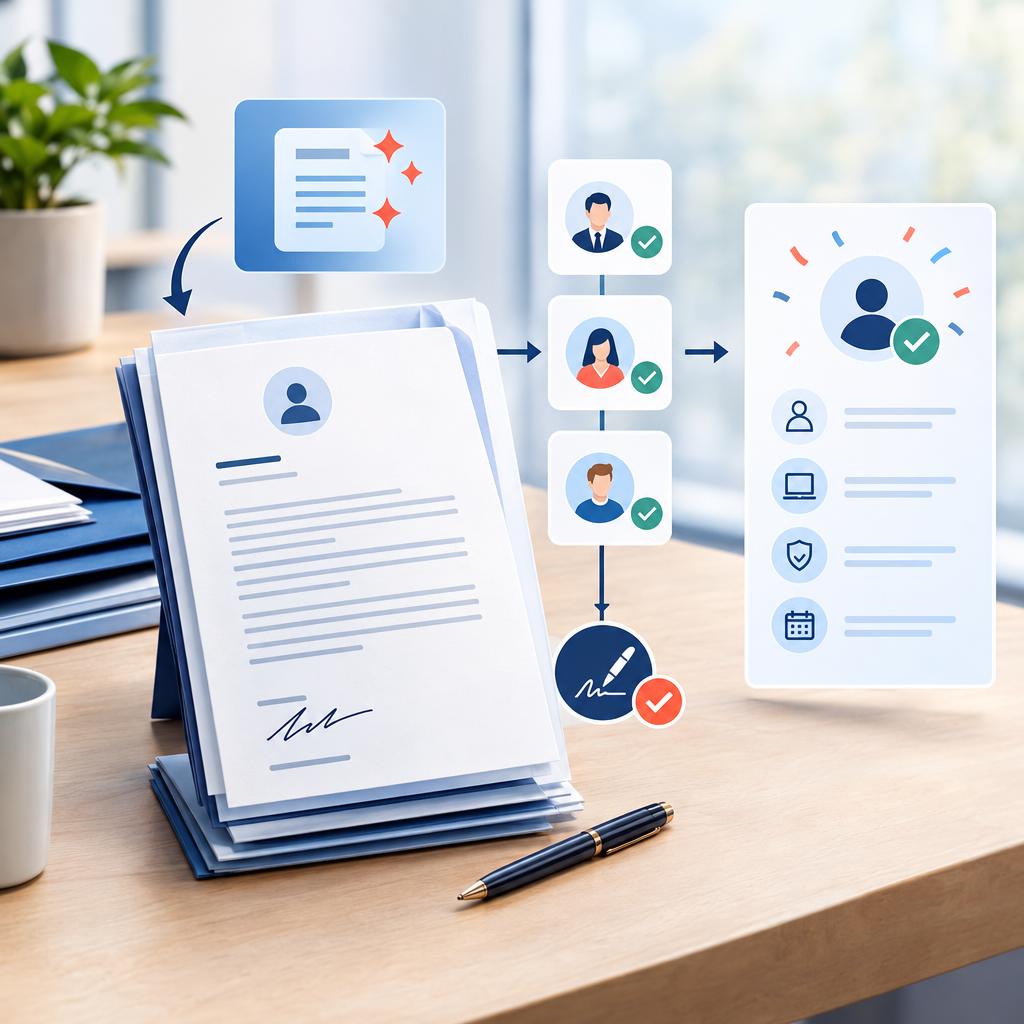
The AI Offer Letter Generator & Approval Sequencer produces tailored, legally mindful offer letters from your templates and candidate data, then routes them through the right approvers and e-signature flows. It reduces time spent drafting and chasing approvals while keeping version history and candidate status visible to HR.
implementi.ai operates and maintains the automation as a managed monthly service: we connect the agreed systems, tune templates and approval rules, monitor the automation, and handle errors or updates so your team can focus on hiring and onboarding.
Das Problem
Creating offer letters is often manual: recruiters copy templates, edit terms for each candidate, attach benefits information and chase signatures across email. Approval rules differ by role, salary band or country, so delays and inconsistencies are common. Missing clauses, wrong start dates or mismatched compensation details cause rework and lost candidate momentum. As hiring volume grows, the admin burden multiplies and HR teams spend disproportionate time on document hygiene instead of candidate experience and strategic tasks.

Was diese Lösung automatisiert
This product automates generation, routing and tracking of candidate offers and the immediate onboarding triggers that follow acceptance. The managed service configures templates, approval routing, signature sequencing and basic compliance checks using customer-provided rules.
- Generate personalised offer letters from templates and candidate/role data.
- Apply band/role-specific clauses and country-specific text blocks.
- Route offers through configured approval chains (recruiter, hiring manager, compensation reviewer, legal).
- Deliver offers to candidates via secure e-signature providers and track signature status.
- Trigger onboarding tasks in HRIS/Onboarding tools after acceptance (start-date notifications, equipment requests, payroll handoff).
- Flag exceptions for manual review (negotiations, unusual compensation structures, missing approvals).
Was Ihr Unternehmen davon hat
- Faster offer turnaround. Automated generation and routing remove drafting and approval bottlenecks so offers reach candidates sooner and reduce time-to-accept.
- Consistent, compliant letters. Template controls and block insertion ensure role- and location-specific clauses are applied consistently, reducing rework and legal review time.
- More predictable approvals. Built-in approval chains and escalation rules reduce email back-and-forth and make it clear who must sign off before an offer is issued.
- Smoother handoff to onboarding. Accepted offers automatically trigger downstream tasks in HRIS and IT request flows, reducing missed setup steps and first-day gaps.
- Weniger manuelle Fehler. Data-driven population of compensation, start dates and benefits reduces copy-paste mistakes and avoids conflicting candidate communications.

Ein praktischer Anwendungsfall
A mid-sized company that hires across software, sales and customer success roles centralises offer-generation. Recruiters use the ATS to advance a candidate to the offer stage; the automation pulls role, compensation band and candidate details to create a tailored offer letter. The offer is routed automatically to the hiring manager and compensation reviewer for approval, then sent to the candidate via an e-signature provider. When signed, HR receives a single status update and the onboarding checklist starts: payroll entry, equipment request and welcome tasks are created. Exceptions—such as negotiated salary or deviating start date—are flagged for human review.
Für wen ist es gedacht?
- Talent acquisition teams in growth-stage and mid-market companies who issue frequent offers and need consistent templates.
- People operations teams that want to reduce manual document work and create reliable onboarding handoffs.
- Companies with multi-step approval rules (hiring manager, budget owner, legal) that need automated sequencing to avoid delays.
- Organisations using an ATS and HRIS that want connected offer → hire → onboarding flows.
Was ist im monatlichen Service enthalten?
The monthly subscription covers the managed automation and ongoing operation of the agreed offer-generation and routing solution. implementi.ai configures connections with your systems, maintains templates and approval rules, runs the AI-based document generation, monitors the automation and fixes operational errors. The service also includes reasonable configuration updates when job bands, clauses or routing rules change.
- Operating the automation and AI document generation
- Vor der Einführung vereinbarte Systemanbindungen
- Monitoring operation and handling/fixing automation errors
- Monthly maintenance and configuration updates as agreed
Wann diese Lösung möglicherweise nicht erforderlich ist
- Organisations issuing only occasional offers (infrequent hiring) where manual workflows are already lightweight.
- Complex, heavily negotiated executive offers that require bespoke legal drafting and bespoke external law workflows; those may need a higher-touch legal review process.
So funktioniert es
- Candidate advances to offer stage. When a recruiter marks a candidate as ready in the ATS, the automation collects candidate profile, role, compensation band and offer metadata to prepare a draft.
- Template population. The AI engine populates the selected offer template with the candidate and role data, inserts location- and band-specific clauses and prepares variable sections such as bonus, equity or relocation language.
- Approval sequencing. The draft is routed automatically to configured approvers in order (for example hiring manager → compensation reviewer → legal). Approvers receive a summary and approve, request changes, or escalate.
- Candidate delivery and signing. Once approved, the offer is sent to the candidate through the agreed delivery method and e-signature provider; signature status is tracked and updated back to the ATS/HRIS.
- Exception handling and negotiation. If the candidate requests changes or negotiates terms, the automation either generates a revision for approval or routes the request to HR for manual handling, depending on configured rules.
- Onboard triggers on acceptance. When the offer is signed, the system triggers downstream onboarding tasks: HRIS status change, payroll entry, equipment request and welcome checklist items.
- Audit trail and history. All versions, approvals and signatures are recorded so teams can review offer history and reconcile terms if questions arise.
Beispiel-Workflow
For example, imagine a company that hires ten engineers a month. A recruiter marks a finalist in the ATS and selects the appropriate job band. The automation pulls the candidate name, role and salary band, fills the approved template with the relevant benefits and location-specific clauses, then routes the draft to the hiring manager and compensation approver. After approvals, the offer is sent via DocuSign for signature. The signed document status updates the ATS and triggers an onboarding checklist in the HRIS: payroll entry, account provisioning, and equipment ordering. If the candidate negotiates salary, the draft is returned to HR for review and the revised letter follows the same approval path.
Integrationen
Typische Systeme
Typical systems that teams connect include Applicant Tracking Systems (examples: Greenhouse, Lever), HRIS platforms (examples: BambooHR, Workday), e-signature providers (examples: DocuSign, Adobe Sign), document storage (Google Drive, SharePoint) and onboarding or IT ticketing tools. Other systems can potentially be connected via agreed APIs or file exchanges; compatibility is confirmed during scoping.
Anschlussarten
Connections are implemented via available APIs and native integrations when possible, webhooks from the ATS, secure e-signature provider APIs, or agreed file exchanges (CSV/SFTP) and Google Sheets for lower-complexity setups. implementi.ai confirms the exact method for each system before launch.
Was wir von Ihrem Unternehmen benötigen
Before launch we agree the ATS/HRIS/e-signature providers to integrate, provide canonical offer templates and clause rules, define approval chains and exception rules, and share a test account or read/write API credentials where required. We also need examples of typical offers and an estimate of monthly hiring volume so we can size the workflow and tune templates. Final compatibility and the chosen connection method are confirmed during scoping.
Häufig gestellte Fragen
Which ATS, HRIS and e-signature systems are supported?
We commonly integrate with Greenhouse, Lever, BambooHR, Workday and major e-signature providers like DocuSign and Adobe Sign, plus Google Workspace and Microsoft 365. During scoping we confirm access methods and compatibility for your specific systems.
How customisable are the templates and approval rules?
Templates, clause blocks and approval chains are fully configurable during implementation. implementi.ai helps set up standardised templates and will apply reasonable updates as part of the managed monthly service.
Will offers ever be sent without human approval?
We configure routing to match your policies. You choose whether certain bands or roles auto-approve or always require manual approval. implementi.ai implements and enforces those agreed rules; exceptions are flagged for human review.
How are negotiations handled?
If a candidate requests changes, the automation can create a revision and route it through the same approval chain or pause and notify HR for a manual decision, depending on your configured rules.
Wovon hängt der monatliche Preis ab?
Key drivers are the number and type of integrations (ATS, HRIS, e-signature), the complexity of approval rules and template variations, and expected monthly offer volume. We confirm scope and price before implementation.
Wie beginnen wir mit der Umsetzung?
We begin with a scoping call to list systems, sample templates and approval rules. implementi.ai then defines the integration approach and confirms timelines and launch readiness before work begins.
Preis
Die Aktivierungsgebühr deckt die Ersteinrichtung, die Implementierung und die Inbetriebnahme des vereinbarten Automatisierungsumfangs ab.
Das monatliche Abonnement umfasst den laufenden Betrieb, die Wartung und die Verwaltung des Automatisierungsdienstes.
Der genaue Umfang und die endgültige monatliche Abonnementgebühr werden vor dem Start bestätigt.
Sind Sie bereit, diesen Prozess zu automatisieren?
Tell us which ATS, HRIS and e-signature providers your company currently uses and your typical monthly hiring volume.
Wir werden klären, wie diese Lösung angeschlossen werden kann, welchen Umfang sie hat und wie hoch die monatliche Abonnementgebühr letztendlich sein wird.
Buchen Sie ein 30-minütiges Telefonat
| Schreiben Sie uns eine E-Mailcontact@implementi.ai | Rufen Sie uns an+48 660 983 178 |