Beschreibung
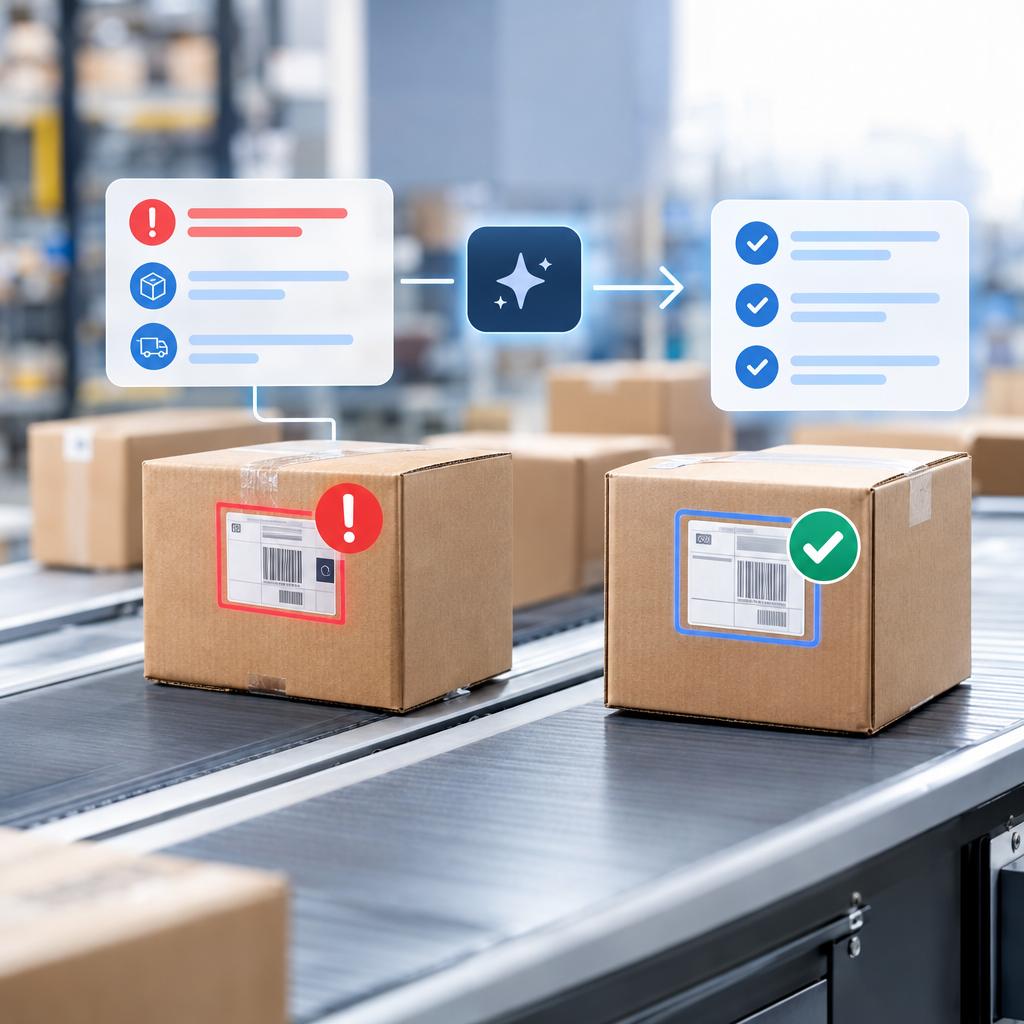
The AI Packing Exception Detector watches order pack events, scanner/scale data and packing lists to find mismatches—wrong SKU, missing item, quantity or weight exceptions—then routes resolution actions automatically. It reduces manual triage by surfacing true exceptions and initiating corrective actions where they matter: at the packing station, in the warehouse management system, or with customer service.
implementi.ai provides the managed service: we configure and connect your systems, operate the automation, monitor its health and handle fixes and configuration updates as part of the monthly subscription.
Das Problem
Without automation, packing exceptions are discovered downstream—during dispatch checks, customer complaints or returns—which forces time-consuming investigations, stock reconciliations and customer recovery work. Packing teams often work from paper or disconnected scanning flows; exceptions are logged in spreadsheets, tickets are created manually and communication between warehouse, OMS and customer service is inconsistent. As order volumes grow, the number of exceptions and the cost to resolve them increases non-linearly, causing shipping delays, increased returns and extra labour for manual reconciliation.

Was diese Lösung automatisiert
This service continuously monitors pack events and related data, detects likely packing exceptions and automates the corrective workflow. The solution can:
- Detect quantity, SKU and weight mismatches from packing station scans and scale readings.
- Create and prioritise exception records in your WMS/OMS or ticketing system.
- Route tasks to packers, QA or re-pick teams with contextual details and suggested fixes.
- Update order status in the OMS/ERP and, where appropriate, send templated customer notifications or hold shipments.
- Collect exception metrics and maintain an ongoing history for trend analysis and periodic review.
Was Ihr Unternehmen davon hat
- Fewer outbound errors. Detect mismatches before dispatch so incorrect orders are corrected at the packing station rather than returned by customers, saving time and operational cost.
- Schnellere Behebung von Ausnahmen. Automatically route clear, contextual tasks to the right team or person instead of relying on manual ticket creation and ad-hoc communication.
- Eindeutiger Prüfpfad. Maintain structured records of packing incidents, actions taken and outcomes to support claims, stock corrections and continuous improvement.
- Weniger Kundenkontakte. Automate customer-facing notifications only when necessary and with consistent messaging that reduces incoming support volume.
- Betriebliche Transparenz. Provide managers with exception dashboards and trend data so recurring issues (SKU confusion, packing-station faults) can be fixed at source.

Ein praktischer Anwendungsfall
For a mid-size online retailer fulfilling thousands of orders per week, packing stations use handheld scanners and bench scales. When a packer scans an item that doesn’t match the order or the weight is outside expected tolerance, the detector flags the order. The automation opens an exception, captures the scanned items, suggests a re-pick or manual verification, notifies the packing lead and temporarily holds the shipment in the OMS. If a human confirms the pack was correct, the automation clears the hold and updates the order; if not, it triggers re-pick instructions and updates inventory records. This keeps most issues out of customer support and prevents incorrect shipments.
Für wen ist es gedacht?
- High-volume e-commerce retailers — need automated exception handling to protect dispatch accuracy and customer experience.
- 3PLs and fulfilment centres — require consistent routing of packing issues across multiple clients and SLAs.
- Retail chains with ship-from-store or omnichannel fulfilment — benefit from real-time packing checks at distributed locations.
- Warehouse operations managers — want fewer manual investigations and clearer metrics to improve packing processes.
Was ist im monatlichen Service enthalten?
The monthly subscription covers the managed automation and ongoing operation: we configure and operate the detection and routing workflows, connect agreed systems, run the AI processing that classifies and prioritises exceptions, and monitor the automation’s operation. The service includes handling and fixing automation errors, routine maintenance and reasonable configuration updates to keep the solution aligned with evolving packing rules and SKU changes.
- Operating the automation and connected services
- Connections agreed before launch (WMS/OMS/e-commerce or ticketing)
- AI processing to detect and classify exceptions
- Monitoring, error handling and reasonable updates
Wann diese Lösung möglicherweise nicht erforderlich ist
- Very small sellers with under ~100 orders/month and no scanning or packing data — the automation may be excessive.
- Operations that rely entirely on manual, unstructured packing (no digital scan or weight capture) without a plan to provide machine-readable inputs.
So funktioniert es
- Collect pack events. The automation listens for packing events from your packing stations, scanners, scale middleware or the WMS and gathers order details, scanned SKUs and weight measurements.
- Normalise and compare. Collected data is normalised against the order line, expected SKU dimensions and weight tolerances to detect mismatches or missing items.
- Classify the exception. AI classifiers assign an exception type (e.g. wrong SKU, missing item, weight variance) and a suggested severity and action path to reduce manual triage.
- Open and route a task. The system creates an exception record in the agreed destination (WMS ticket, support queue or task board) and routes it to the appropriate team or packing station with contextual details.
- Trigger corrective actions. Based on rules, the automation can suggest a re-pick, initiate a hold in the OMS, or send a templated customer notification pending investigation.
- Prüfung durch einen Mitarbeiter und Lösung des Problems. Warehouse staff review the exception, confirm the corrective step (re-pick, override or cancel), and complete the task; the automation records the decision and updates order and inventory systems.
- Audit and trend reporting. Resolved exceptions and metadata are stored to produce recurring reports and help identify root causes like mislabelling or packing-station errors.
Beispiel-Workflow
For example, imagine a company that ships apparel and accessories from a central warehouse. A packer scans the barcode at the packing station and places the parcel on a bench scale. The automation receives the scan and weight, compares them to the order and product expected weight, and detects a weight variance that suggests a missing accessory. It creates an exception ticket in the WMS, routes the task to the packer’s supervisor with the scan history and a suggested re-pick, and places the order on hold in the OMS. After the supervisor confirms a missing item and instructs a re-pick, inventory is adjusted and the automation clears the hold, allowing shipment to proceed with updated records.
Integrationen
Typische Systeme
Typical systems may include warehouse management systems (WMS) such as SAP EWM or other API-enabled WMS, order management and e-commerce platforms (Shopify, Magento, BigCommerce or custom OMS), ERP systems (NetSuite, SAP), carrier/shipping APIs and packing-station scanner/scale middleware. Other systems can potentially be connected when compatibility is confirmed before launch.
Anschlussarten
Connections are implemented through available APIs and webhooks where supported, or via secure file exchange (SFTP/CSV), middleware used by scanner/scale devices, and ticketing/WMS integrations. We agree the exact methods during scoping and confirm compatibility before implementation.
Was wir von Ihrem Unternehmen benötigen
Before launch we need a list of the systems you want connected, sample order and pack-event data (scans, weights), SKU master data and mappings, your packing tolerance rules and business decision rules for holds and customer notifications. We also agree target destinations for exception records (WMS ticket queue, support system or task board) and who can approve overrides. Compatibility, access methods and exact scope are confirmed in the pre-launch phase.
Häufig gestellte Fragen
Which packing data sources do you support?
We typically connect to packing station middleware, scanner and scale systems, WMS/OMS APIs or secure CSV exports. During scoping we confirm the available interfaces and recommend the most reliable integration path for your environment.
Wie wird mit Fehlalarmen umgegangen?
The system classifies exceptions and provides suggested actions; you can configure tolerance thresholds and approval flows to reduce false positives. implementi.ai will monitor early performance and adjust rules as part of the managed service.
Do warehouse staff need to learn a new tool?
We surface exception tasks inside your existing WMS, ticketing system or task board where possible. Minimal training is needed for staff to review and resolve tasks; implementi.ai supports the initial change management and reasonable configuration updates.
What happens when the automation fails?
implementi.ai monitors the automation and handles error detection and fixes as part of the monthly service. Critical failures are escalated through agreed channels and we deploy corrective changes or workarounds until normal operation resumes.
How does pricing scale with volume and integrations?
Monthly pricing reflects the number and complexity of integrations, processing frequency and operational support needed. During scoping we confirm the expected event volume and integrations to recommend the correct tier.
Preis
Die Aktivierungsgebühr deckt die Ersteinrichtung, die Implementierung und die Inbetriebnahme des vereinbarten Automatisierungsumfangs ab.
Das monatliche Abonnement umfasst den laufenden Betrieb, die Wartung und die Verwaltung des Automatisierungsdienstes.
Der genaue Umfang und die endgültige monatliche Abonnementgebühr werden vor dem Start bestätigt.
Sind Sie bereit, diesen Prozess zu automatisieren?
Tell us which WMS, OMS and packing-station scanner or scale systems you use and the average monthly order volume.
Wir werden klären, wie diese Lösung angeschlossen werden kann, welchen Umfang sie hat und wie hoch die monatliche Abonnementgebühr letztendlich sein wird.
Buchen Sie ein 30-minütiges Telefonat
| Schreiben Sie uns eine E-Mailcontact@implementi.ai | Rufen Sie uns an+48 660 983 178 |