


Beschreibung
The AI Shipping Label Error Detector watches every label generation and carrier response in real time, flags errors and either applies automated fixes or routes exceptions for quick human action. It reduces the manual triage required when labels are rejected by carriers, addresses are formatted incorrectly or shipment options are invalid for a parcel.
implementi.ai configures and operates the service: we connect your shipping platforms and carriers, create retry and remap rules specific to your logistics policies, and maintain the automation so it continues to handle label exceptions reliably month to month.
Das Problem
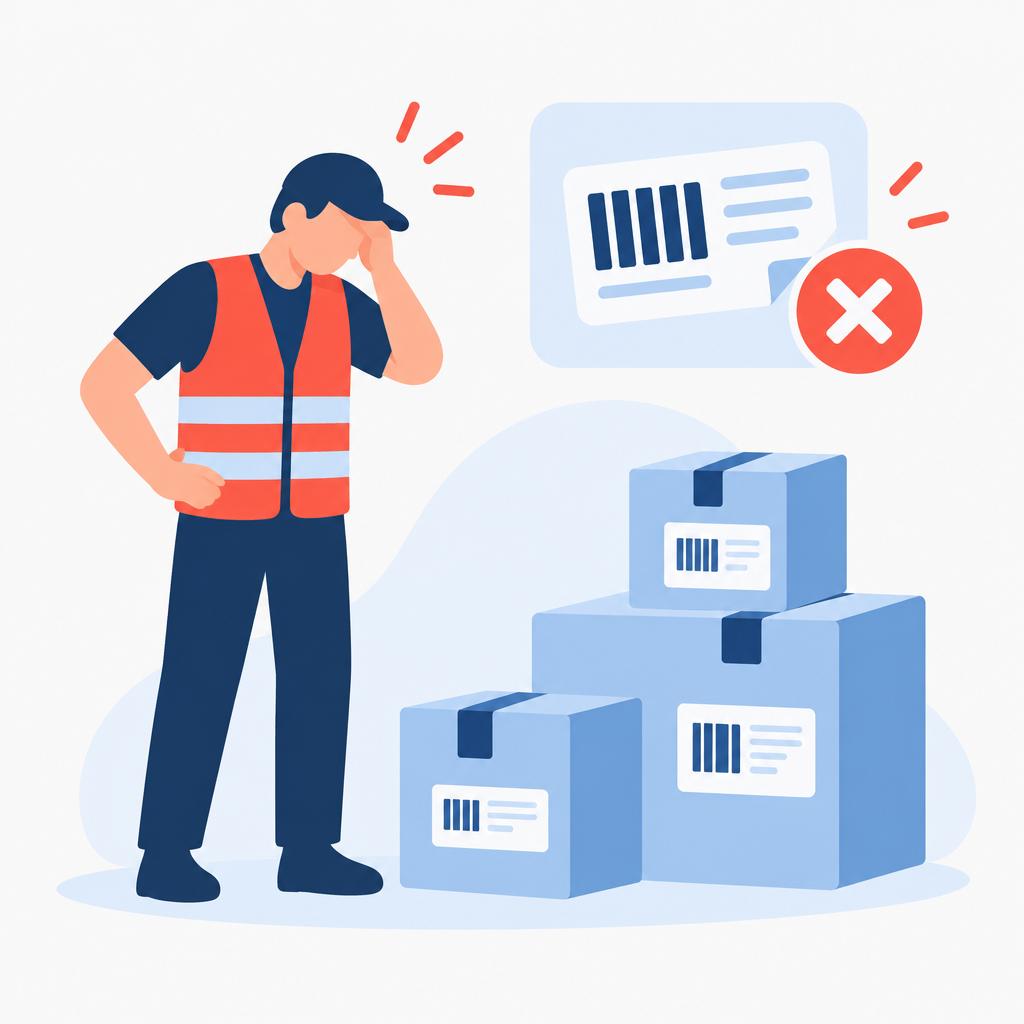
When fulfilment teams create shipping labels at scale, failures are common: carriers can reject labels for invalid addresses, unsupported service levels, parcel size mismatches, or missing customs data. Teams often discover these errors only during batch processing or at carrier pickup, forcing manual rework, cancelled shipments and customer messages. As order volumes grow the number of exceptions scales non-linearly and becomes a persistent operational cost. Accurate tracking of retries, reasons and outcomes is essential to avoid repeated mistakes and to keep carriers and customer-facing teams informed.
Was diese Lösung automatisiert
This managed automation continuously monitors label creation and carrier responses, classifies failures, and executes corrective paths. Actions are configurable per customer and executed under the agreed ruleset; implementi.ai operates and maintains the logic so it evolves with carrier rules and your fulfilment patterns.
- Detect failed or rejected label requests from carrier APIs, shipping middleware or platform webhooks.
- Classify the failure reason (address, service level, parcel dimensions, customs data, rate limits).
- Apply automated corrective actions such as address normalization, package dimension adjustments, service-level remapping or carrier fallback retries.
- Retry label creation with alternate carriers or adjusted shipment data when rules allow.
- Open and update carrier support tickets or surface human approval tasks for unresolved exceptions.
- Log attempts, outcomes and retry history for auditing and trend analysis.
Was Ihr Unternehmen davon hat
- Fewer manual exceptions. Automates repetitive correction and retry steps so operations staff spend less time fixing predictable label problems and more time on value work.
- Shorter fulfilment cycle times. Earlier detection and automated retries reduce delays between order packing and carrier acceptance, improving on-time dispatch.
- Consistent carrier handling. Centralised, configurable rules enforce company policies for carrier selection, fallback and service-level adjustments, reducing ad-hoc decisions.
- Clear exception visibility. Structured logs and status updates keep customer service and ops teams informed about retry attempts and outstanding issues.
- Managed, evolving operations. implementi.ai operates and updates the logic to reflect carrier API changes or new business rules, lowering internal maintenance overhead.

Ein praktischer Anwendungsfall
A mid-size e-commerce merchant sends thousands of shipments per week using a mix of shipping middleware and direct carrier APIs. During peak periods, certain addresses and oversized parcels cause carriers to reject labels, and ops staff must manually re-enter shipments with alternate carriers or corrected dimensions. With this service, the automation detects rejected labels immediately, attempts standardised fixes (for example normalising the address format or switching to a compatible service level), and retries with a second carrier automatically. Only complex or policy-sensitive exceptions are escalated to humans, reducing daily manual tickets and securing faster dispatch.
Für wen ist es gedacht?
- Direct-to-consumer e-commerce teams: need reliable label processing across multiple carriers and irregular address formats.
- Third-party logistics (3PL) providers: need to reduce manual rework when handling many clients using different carrier preferences.
- Enterprises with mixed carriers and WMS systems: require consistent retry and fallback rules across platforms.
Was ist im monatlichen Service enthalten?
The monthly subscription covers a fully managed automation: setup of carrier and platform connections agreed before launch, continuous monitoring of label events, application of configured retry and correction rules, and handling or routing any unresolved exceptions. implementi.ai also monitors the automation’s operation, fixes failures in connectors or logic as they arise and applies reasonable configuration updates to keep the solution working with evolving carrier requirements.
- Operating automation and processing of label events
- Connections with agreed systems and carrier APIs
- Monitoring and maintenance of the automation
- Handling and fixing automation errors and reasonable updates
Wann diese Lösung möglicherweise nicht erforderlich ist
- Businesses that create only a handful of shipments weekly and handle exceptions manually without scaling pressures.
- Customers requiring bespoke carrier integrations that cannot be connected by standard APIs or agreed methods; compatibility is checked during scoping.
So funktioniert es
- Ereigniserfassung. The service listens for label-generation events from your e-commerce platform, shipping middleware or WMS and ingests carrier API responses and webhooks.
- Failure classification. Each failed or rejected label is classified into meaningful categories (address, dimensions, rate-limit, service mismatch, customs) to determine the correct remediation path.
- Automatisierte Korrekturmaßnahmen. For routine issues the automation applies fixes such as address standardisation, dimension corrections or service remapping according to your rules, then retries label creation automatically.
- Carrier fallback. If the primary carrier refuses the label and policy allows, the workflow attempts a retry with a pre-authorised alternate carrier or service level and records the result.
- Eskalation und manuelle Überprüfung. Exceptions that cannot be resolved automatically are routed as a concise task to operations or customer service with the error context and suggested fixes for rapid resolution.
- Logging and reporting. All attempts, outcomes and decision reasons are logged to a central history to support audits and continuous improvement.
- Laufende Feinabstimmung. implementi.ai monitors automation performance and adjusts rules and connectors as carriers change APIs or your fulfilment policies evolve.
Beispiel-Workflow
For example, imagine a company that ships internationally from an e-commerce platform. A batch of labels is created overnight and the DHL API rejects 12% because the customs description field is incomplete. The automation ingests the carrier rejection codes, classifies them as missing customs data, enriches shipments by combining product SKUs and merchant-provided descriptions to populate the customs field, and retries label creation. Where automated enrichment is insufficient, the system falls back to a secondary carrier with looser customs requirements or creates a single human task listing the affected orders and suggested corrections. Operations reviews only the unsolved items while the rest proceed to carrier acceptance.
Integrationen
Typische Systeme
Typical systems include e-commerce platforms and marketplaces (Shopify, WooCommerce, Magento), shipping middleware (ShipStation, Shippo), carrier APIs (DHL, UPS, FedEx, national carriers), WMS or ERP systems (warehouse management, Netsuite, SAP) and order management systems. These are examples — final compatibility is confirmed during scoping and we adapt to the platforms you actually use.
Anschlussarten
We connect using available carrier APIs and webhooks from shipping middleware or platforms. Alternate methods include SFTP/CSV batch feeds from WMS, inbound emails with shipment confirmations, or a lightweight connector to your order management system. The chosen method is agreed before launch based on your systems and security model.
Was wir von Ihrem Unternehmen benötigen
Before launch we agree the systems to connect, sample shipment records, API credentials or feed access, your carrier preference and fallback rules, and the business rules for automatic fixes versus human approval. We also need examples of typical label errors you want automated. Compatibility and exact access methods are confirmed before implementation so the service is scoped correctly.
Häufig gestellte Fragen
Which carriers and platforms can you connect to?
We commonly integrate with shipping middleware (ShipStation, Shippo), major carrier APIs (DHL, UPS, FedEx, local carriers) and e-commerce platforms (Shopify, WooCommerce, Magento). Exact compatibility is confirmed during scoping and we adapt to the systems you already use.
In welchem Umfang sind Anpassungen erforderlich?
We configure retry rules, address-normalisation logic and carrier fallbacks to match your fulfilment policy. Standard setups cover most use cases; more complex routing or custom carrier mappings require additional configuration agreed during scoping.
What happens when an exception cannot be fixed automatically?
Unresolved exceptions are routed as concise tasks to your operations or customer service team with the failure reason and suggested corrective steps. The automation logs context to speed human resolution and records the outcome for future tuning.
How do you handle changes to carrier APIs or rate limits?
implementi.ai monitors integration health and updates connectors and rules as carriers change APIs. Maintenance and fixes to keep the agreed solution operational are included in the monthly service.
Will the system throttle retries to avoid carrier rate limits?
Yes — retry behaviour includes backoff and rate-limit awareness according to your carrier and middleware constraints. We configure safe retry windows and alternate paths to prevent repeated rapid failures.
Preis
Die Aktivierungsgebühr deckt die Ersteinrichtung, die Implementierung und die Inbetriebnahme des vereinbarten Automatisierungsumfangs ab.
Das monatliche Abonnement umfasst den laufenden Betrieb, die Wartung und die Verwaltung des Automatisierungsdienstes.
Der genaue Umfang und die endgültige monatliche Abonnementgebühr werden vor dem Start bestätigt.
Sind Sie bereit, diesen Prozess zu automatisieren?
Tell us which e-commerce platform, shipping middleware and carriers you currently use and a typical weekly shipment volume.
Wir werden klären, wie diese Lösung angeschlossen werden kann, welchen Umfang sie hat und wie hoch die monatliche Abonnementgebühr letztendlich sein wird.
Buchen Sie ein 30-minütiges Telefonat
| Schreiben Sie uns eine E-Mailcontact@implementi.ai | Rufen Sie uns an+48 660 983 178 |