
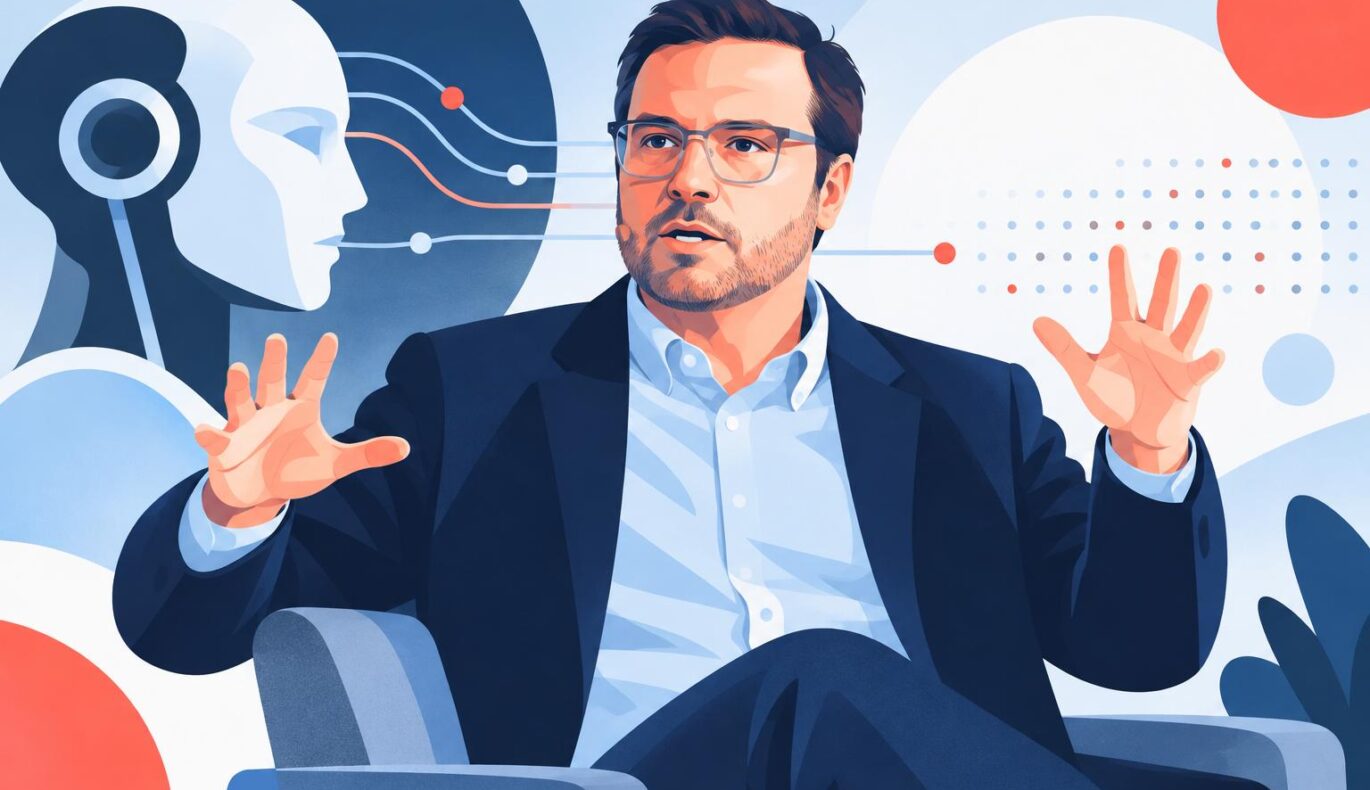
Kevin Roose, journalist and author of The AGI Chronicles, argues that the artificial intelligence industry has moved from speculating about artificial general intelligence (AGI) to organizing its businesses around building it. That shift matters even for companies far from frontier labs: the same systems are increasingly being sold as practical automation tools, while their developers continue making expensive, uncertain bets on a much larger goal.
From research ambition to commercial race
In a conversation on Decoder, Roose described how frontier labs changed as large language models began producing results that many researchers had previously considered implausible. The transformer architecture, published by Google researchers in 2017, became the foundation for the systems behind ChatGPT and similar products. Roose’s central observation is that next-token prediction has continued to generalize surprisingly well, encouraging companies to believe that further scaling could produce broader forms of intelligence.
That belief now sits alongside a more conventional business reality. OpenAI, Anthropic and Google are not only research organizations; they are also trying to sell enterprise software, attract customers and fund the considerable cost of computing infrastructure and staff. Roose characterizes enterprise sales as a way to keep the “flywheel” moving while companies continue pursuing more capable models and agents.
The tension is significant. A company focused on near-term margins might prioritize improving inference efficiency, serving existing customers and selling reliable features. A company convinced that a major capability breakthrough is within reach may instead direct capital toward training, computing capacity and coding systems intended to support longer-running autonomous work. The article presents this as a strategic tradeoff, not a settled formula for success.
Why capability does not eliminate brittleness
The interview also highlights a persistent distinction between impressive demonstrations and dependable automation. Roose is optimistic that language models could eventually reach AGI, but the discussion acknowledges that current systems can still fail when tasks are poorly specified, feedback is ambiguous or the surrounding software provides no clear way to recognize an error.
That limitation is particularly relevant to businesses adopting AI automation. A model may perform well on coding, document analysis or other tasks with clear outputs and verification criteria. It may be much less dependable when asked to navigate inconsistent websites, interpret undocumented processes or make judgment calls across several systems without human review.
For founders, agencies and operations teams, the practical lesson is not to choose between enthusiasm and rejection. It is to separate capability from reliability. An automation can be genuinely useful while still requiring checkpoints, permissions, audit logs, fallback procedures and a person responsible for exceptions.
What this means for businesses
- Design around verifiable outcomes. Automations are easier to trust when success can be checked through structured data, tests, approvals or reconciliation against a source of truth.
- Budget for operations, not just model access. API or software fees are only part of the cost. Teams also need monitoring, workflow maintenance, security controls and time to handle failures.
- Keep strategic flexibility. The competitive landscape may favor a small number of large providers, but the interview leaves open questions about pricing, open-weight models, compute demand and regulation. Avoid building critical processes around untested assumptions about which vendor or model will dominate.
Roose’s wider argument is cultural as much as technical: a relatively small community of researchers, executives and investors is making decisions with potentially broad consequences. Whether or not AGI arrives on the timelines its advocates suggest, businesses and policymakers still have to deal with increasingly capable systems now. The sensible response is neither to accept every industry prediction nor to dismiss the technology outright, but to understand where automation works, where it breaks and who remains accountable when it does.
Source: Read the original reporting. This article adds general analysis and practical context to the source report.
Explore more: Looking for practical AI automation in your business? Visit the Implementi.ai automation shop.