Description
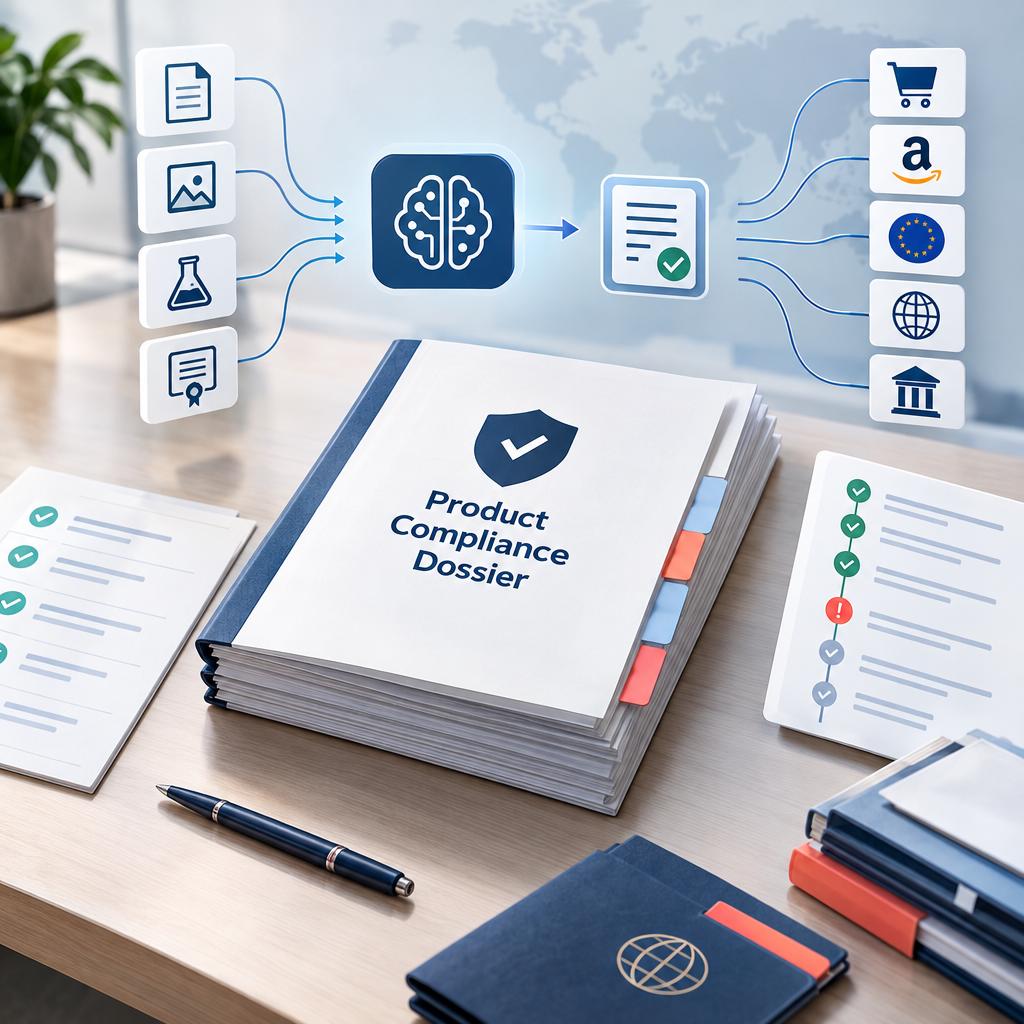
The AI Product Compliance Dossier Builder assembles, validates and tracks the documents required to sell regulated products across marketplaces and jurisdictions. It reduces manual file chasing, inconsistent declarations and late non-compliant listings by producing an auditable dossier for each SKU and monitoring submission status.
implementi.ai configures the integrations, runs the AI-driven extraction and quality checks, monitors the automation and handles exceptions so your team receives packaged, validated compliance files and a continuous tracker to follow approvals and outstanding items.
The problem
Many organisations manage product compliance with spreadsheets, email threads and ad-hoc file folders. Product managers and compliance teams spend hours chasing certificates, SDS, declarations of conformity, test reports and translated labels. Documents are often incomplete, fields are inconsistent between systems, and marketplace or regulator uploads are blocked by missing metadata. As SKUs, markets and regulatory rules scale, the administrative burden grows non-linearly and the risk of rejected listings or last-minute fixes increases. Continuous, auditable control over which documents exist and which still need action is difficult without an automated process.

What this solution automates
This service automates the assembly, verification and tracking of product compliance dossiers and the routing of exceptions to the right team member. The managed automation can perform:
- Extraction and normalisation of fields from incoming documents (PDFs, images, spreadsheets).
- Validation against predefined rules per product category and target marketplace/regulator.
- Automatic assembly of a packaged dossier (required documents + metadata) for each SKU or product family.
- Automated submission or preparation for upload to marketplace APIs or regulator portals where supported.
- Exception routing and status tracking with reminders and handover notes for manual review.
- Maintained version history and a searchable index of compliance evidence.
What your business gains
- Faster compliance packaging. Reduce manual document collection and assembly time by producing ready-to-submit dossiers automatically, so listings and shipments are not delayed by missing paperwork.
- Fewer listing rejections. Consistent validation against marketplace and regulatory rules lowers the chance of rejection or delisting caused by incomplete or inconsistent declarations.
- Clear ownership of exceptions. Automated routing and prioritized exception lists ensure the right person receives the exact missing documents or corrective actions to close compliance gaps.
- Audit-ready history. Maintained dossier versions and extraction logs create an auditable trail for internal reviews and external queries without manual filing work.
- Operational scalability. The managed service reduces the incremental administration overhead when adding new SKUs, markets or channels.

A practical use case
For a mid-sized manufacturer expanding into new marketplaces and export destinations, compliance requires a mix of SDS (safety data sheets), component declarations, translated labels and test reports. The product team previously relied on email and shared drives; listings were repeatedly blocked for missing fields. With the AI Product Compliance Dossier Builder, incoming documents attached to product records are auto-extracted and validated, missing items routed to procurement or lab teams, and a completed dossier is created for each SKU. When a marketplace requires a specific declaration or file name format, the system flags the deficiency early and either prepares the upload package or escalates the exception for human approval, preventing last-minute listing failures and shipment delays.
Who is it for?
- Product compliance and regulatory teams at manufacturers — need continuous control of certificates and test reports when selling in multiple jurisdictions.
- Operations teams at omnichannel retailers — require consistent dossiers to prevent marketplace delists and shipping holds.
- Marketplaces and export specialists — benefit from automated packaging and versioned evidence for audit and customs workflows.
- Product managers managing large SKU catalogs — need to scale compliance checks without a proportional increase in manual admin.
What is included in the monthly service
The monthly subscription covers the managed automation and ongoing operational elements: configuration and maintenance of the automation, AI document processing and validation, monitoring of the automation’s operation, handling and fixing automation errors, and reasonable configuration updates to keep the agreed solution working as your rules or target channels change.
- implementi.ai operates the workflow and monitors submissions.
- We handle routine fixes, extraction model tuning and update validation rules when requirements change.
- Any additional integrations or large rule changes are scoped and agreed before implementation.
When this solution may not be necessary
- Small sellers with a handful of SKUs and no regulated documentation needs — the service may be excessive for very low-volume operations.
- Companies that only sell non-regulated, low-risk products and do not require formal declarations or test reports.
How it works
- Connect systems. We link your product data sources, document storage and target channels so product records and incoming documents are visible to the automation.
- Ingest documents. New or existing compliance documents (PDFs, images, spreadsheets) are ingested automatically from configured folders, emails or system attachments and recorded against SKUs.
- Extract and normalise. AI extracts key fields (certificate numbers, expiry dates, test results, language) and normalises them to a standard schema for comparison against rules.
- Validate against rules. The system checks required documents and metadata per product category and target marketplace/regulator; missing or inconsistent items are flagged as exceptions.
- Assemble dossier. When validation passes, the service compiles the required files and metadata into a packaged dossier ready for upload or internal review, and records the version history.
- Submit or prepare uploads. For supported channels the automation can push prepared packages to marketplace APIs or produce correctly named files for manual upload; submission status is tracked centrally.
- Route exceptions & monitor. Exceptions are routed with context and suggested fixes; implementi.ai monitors the automation, resolves operational errors, and applies agreed updates to validation rules.
Example workflow
For example, imagine a company that launches 200 SKUs into two new marketplaces. As product managers attach certificates and translated labels to product records, the automation ingests each file, extracts certificate numbers and expiry dates, and compares them to the marketplace rule set. For one SKU, the system finds a missing translated label and an expired test report. It compiles a dossier for the other SKUs and alerts the compliance owner with the exact missing files and a suggested action list. For the SKU with the expired report, the automation marks it as blocked for submission and retains a versioned audit trail; when the updated test report is uploaded later, the dossier is rebuilt and the product is queued for submission automatically.
Integrations
Typical systems
Typical systems that can be connected include PIMs (Akeneo, Salsify or equivalent), ERPs (SAP, Oracle NetSuite), e-commerce platforms and marketplace APIs (Amazon Seller Central, eBay, Shopify stores), document storage (Microsoft SharePoint, Google Drive), and email or ticketing systems used to submit compliance evidence. Other systems can potentially be connected; final compatibility is confirmed during scoping.
Connection methods
Connections are implemented using available APIs and native integrations where supported, webhooks, monitored document folders (SharePoint, Google Drive), secure SFTP or agreed CSV/data exports, and email ingestion for attachments. Where direct API access to a regulator or marketplace is not available, the service prepares validated upload packages for manual submission. Exact methods are agreed before launch.
What we need from your company
Before launch we agree which systems hold product records and compliance documents, sample documents and product categories, the target marketplaces or regulator channels and the decision rules for acceptable evidence. We also need access methods (API keys, folder locations, or export formats) and designated contacts for exception handling. Compatibility, access method and the final list of required integrations are confirmed during scoping and prior to implementation.
FAQ
Which document types can the system handle?
We routinely process PDFs, scanned images and spreadsheets containing certificates, safety data sheets, lab test reports and label images. During scoping we confirm the specific formats you use and tune extraction for your documents.
Can you submit directly to marketplaces or regulators?
Where a marketplace or regulator exposes a supported API, the automation can prepare and submit packages. If direct submission is not available, we produce validated, correctly named upload packages and track their intended submission status; exact submission methods are agreed before launch.
How are exceptions handled?
Exceptions (missing files, inconsistent fields, expired certificates) are routed to designated owners with context and suggested corrective actions. implementi.ai monitors the automation, handles routine fixes and can update validation rules as requirements change.
Do you keep a history of changes?
Yes. The service maintains a versioned history of assembled dossiers and extraction logs so teams can audit past evidence and see when files were added, changed or validated.
What customization is included in the monthly fee?
The monthly subscription covers ongoing operation, monitoring, routine fixes and reasonable configuration updates to validation rules or integrations. Large-scale changes or new channel integrations are scoped and priced separately.
How do we get started?
We begin with a discovery to identify your document sources, target channels and the validation rules needed. Launch time depends on integrations and scope and is confirmed before implementation.
Price
The activation fee covers the initial setup, implementation and launch of the agreed automation scope.
The monthly subscription covers the ongoing operation, maintenance and management of the automation service.
The exact scope and final monthly subscription are confirmed before launch.
Ready to automate this process?
Tell us which PIM/ERP, document storage and target marketplaces or regulatory channels your company uses.
We’ll confirm how this solution can be connected, its scope and the final monthly subscription.
| Email uscontact@implementi.ai | Call us+48 660 983 178 |