

Descripción
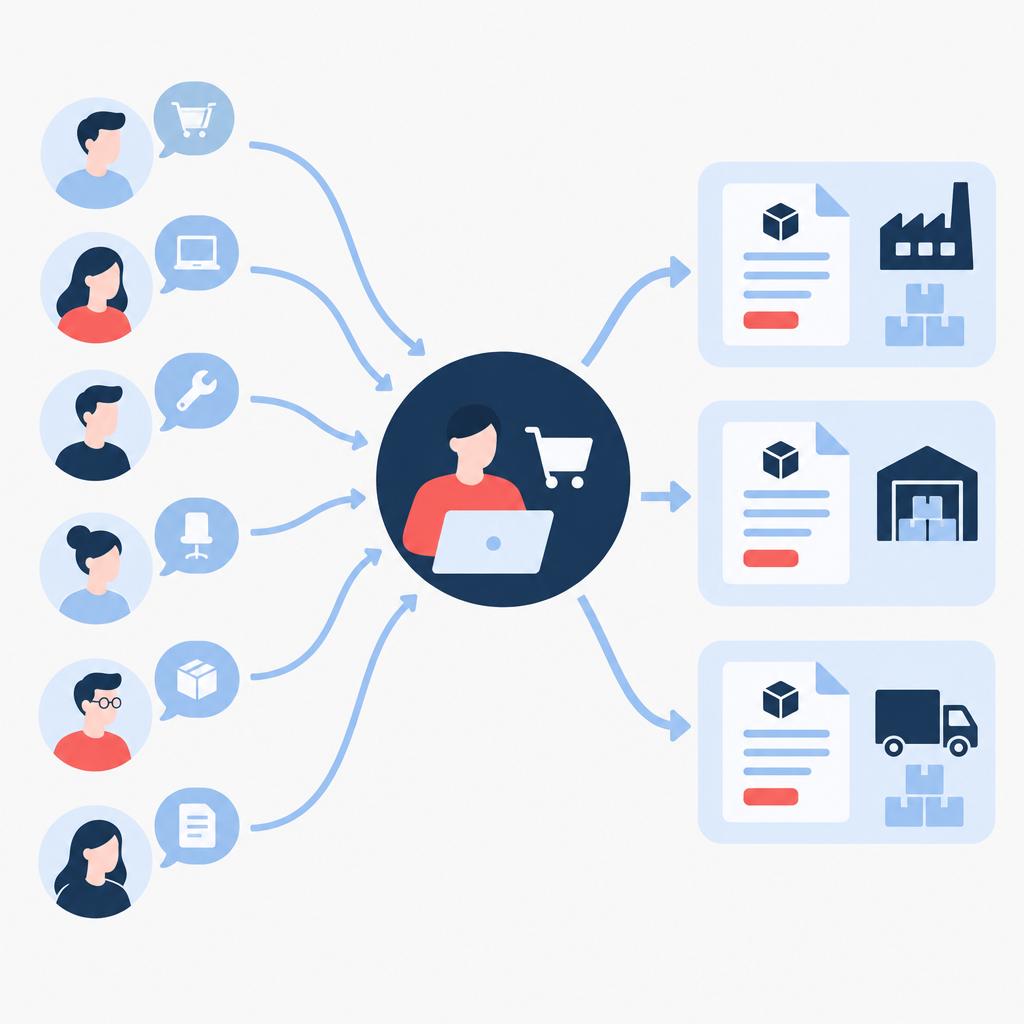
The AI Purchase Requisition Consolidator & PO Batcher collects purchase requests from multiple sources, groups compatible requests, applies approval and budget rules, and produces approval-ready batch purchase orders for your procurement team. It reduces repetitive manual consolidation work and prevents duplicate or fragmented POs that create supplier confusion and extra processing.
Implementi.ai configures and operates the service: we connect the agreed systems, tune grouping and approval criteria with your team, and keep the automation running and maintained as rules evolve.
El problema
Many companies accept purchase requests via email, forms, internal tools and ERP requisition modules. Procurement teams then spend hours matching similar requests, chasing approvals, splitting or merging POs manually and fixing duplicate orders. As headcount and locations grow, this manual triage creates delays, inconsistent supplier communications, budget overspend risks and lost early‑payment savings. Without continuous consolidation and rule enforcement, procurement reacts to noise rather than controlling planned spend.

Qué automatiza esta solución
This managed automation standardises the front-end of procurement by collecting requests, normalising data, grouping items that can be batched, validating against budgets and vendor contracts, and creating draft POs or PO suggestions for approvers.
- Collect requisitions from email, forms, spreadsheets and ERP requisition modules.
- Deduplicate and normalise line items (matching SKUs, descriptions, suppliers).
- Group compatible requests by vendor, delivery window and cost-center to create batch PO drafts.
- Validate against budget, preferred supplier lists and existing open POs.
- Generate approval-ready POs, notifications and exception items for manual review.
- Feed approved POs back to ERP or procurement systems.
Lo que gana tu empresa
- Faster procurement cycles. Reduces time spent manually reconciling and merging requisitions so approvers receive coherent, batched POs instead of dozens of fragmented requests.
- Fewer duplicate or split orders. Automatic deduplication and supplier-matching prevents multiple orders for the same item and improves supplier communications.
- Better budget control. Requests are validated against cost-centres and budget rules before POs are prepared, reducing surprise spend and approval rework.
- Reduced administrative load. Procurement staff spend less time on low-value merging work and more on supplier negotiation and exceptions.
- Consistent supplier batching. Grouping by vendor and delivery window reduces small, frequent orders and simplifies supplier fulfilment.

Un caso práctico
A regional distributor receives purchase needs from warehouse managers, sales teams and finance via email and a shared spreadsheet. Requests often overlap — the warehouse orders the same SKU while sales creates a separate urgent request. The consolidator gathers all inputs, recognises duplicates, groups items that can ship together to the same supplier, checks budgets and creates a batch PO draft that the procurement manager approves. Exceptions (rush items, out-of-contract suppliers or over-budget requests) are flagged for manual review. The result is fewer supplier invoices, clearer delivery windows and less time spent chasing approvals.
¿A quién va dirigido?
- Mid-market distributors and wholesalers: multiple locations and teams submit requisitions and need consolidated POs to control supplier ordering.
- Manufacturers with plant-level buyers: central procurement wants grouped orders by supplier and delivery to reduce supplier fees and admin.
- Service companies with project-based purchasing: projects generate many small requisitions that must be batched by cost-centre and supplier.
- Companies using an ERP with requisition modules but lacking reliable front-end consolidation and approval automation.
¿Qué incluye el servicio mensual?
The monthly subscription covers the managed automation service: we run and monitor the consolidation and batching automation, maintain integrations agreed at launch, handle and fix automation errors, and apply reasonable configuration updates as your approval rules change. Implementi.ai also monitors the automation’s operation and retains responsibility for keeping the agreed flows running.
- Ongoing monitoring and error handling of the automation.
- Maintenance and updates to grouping/validation rules within the agreed scope.
- Operational fixes for integration or data-format issues as they arise.
Cuándo puede que esta solución no sea necesaria
- Organisations with only a single approver and very low monthly requisition volume — manual handling may be simpler.
- Companies that require in-depth sourcing/negotiation per requisition rather than batching — this product focuses on consolidation and routing, not complex supplier sourcing.
Cómo funciona
- Conecta las fuentes de datos. We connect the systems and channels where requisitions arrive — for example, an ERP requisition module, procurement forms, shared spreadsheets and designated inboxes. Implementi.ai confirms the data fields to use for matching.
- Normalise requests. Incoming requests are standardised: item descriptions, SKUs, supplier names and cost-centre codes are normalised so different formats can be compared reliably.
- Deduplicate and match. The automation identifies duplicate or highly similar requests, matches them to known SKUs or vendor catalogues, and marks uncertain matches as exceptions for human review.
- Group and batch logic. Rules are applied to group requests by vendor, delivery window, and cost centre. Grouping criteria are configurable to align with contract terms or logistics constraints.
- Validate against controls. Each batch is checked against budgets, preferred supplier lists and existing open POs. Items that fail validation become exception items routed for manual approval.
- Create batch PO drafts. The system generates approval-ready batch PO drafts and sends them to the configured approver queues with a concise summary and suggested split lines.
- Finalize and sync. After approval, approved POs are sent back into the ERP or procurement system and the automation records the PO numbers and update status for audit and reporting.
Ejemplo de flujo de trabajo
For example, imagine a company that operates three warehouses. Warehouse teams submit purchase requests via a shared form and occasionally by email. The consolidator ingests both inputs, recognises that three requests reference the same SKU for the same supplier, and merges them into one batch with a combined quantity. The batch is validated against the regional warehouse budget and a preferred-supplier rule; because everything checks out, a draft batch PO is created and routed to procurement for approval. If one request exceeds budget, that single line is flagged as an exception for manual review while the rest of the batch proceeds, reducing approval time and preventing duplicate supplier orders.
Integraciones
Sistemas típicos
Typical systems that can be connected include ERP and procurement platforms (for example, SAP, Oracle NetSuite or Microsoft Dynamics 365), e-procurement tools and requisition modules, shared Google Sheets or Excel exports, email inboxes and form tools (e.g., Google Forms or Microsoft Forms). Other systems can potentially be connected where an agreed export or API access is available; compatibility is confirmed during scoping.
Métodos de conexión
Connections are implemented via available APIs or native integrations where possible. When APIs are not available we can use secure webhook endpoints, automated CSV/Spreadsheet imports, monitored inbox parsing for structured emails, or scheduled data exports from your ERP. The exact method is agreed before launch based on the systems you use and their integration options.
Lo que necesitamos de vuestra empresa
Before launch we agree which systems supply requisitions, the fields required for matching (SKU, supplier, quantity, cost centre, requested delivery), approval hierarchies and budget rules, and preferred suppliers or contract constraints. We also need sample data and a point of contact for approval-rule decisions. Compatibility and exact access methods are confirmed during scoping and before implementation.
Preguntas frecuentes
How long does setup usually take?
Launch time depends on the number and type of systems to integrate, the quality of sample data and the complexity of approval rules. We confirm a realistic schedule during scoping; the monthly subscription begins once the agreed solution is live.
Which approval rules can you automate?
We automate typical budget checks, cost-centre validation, preferred-supplier enforcement and delivery-window grouping. Complex legal sourcing or multi-stage negotiation processes are scoped and configured as exceptions to the automation.
What happens to exceptions or unmatched items?
Exceptions — such as unmatched SKUs, over-budget requests or requests for non-preferred suppliers — are routed to a human queue with the relevant context and suggested action. The automation continues processing non-exception items so approvals are not blocked by a few edge cases.
Can this create POs directly in our ERP?
Yes — where the ERP or procurement system supports API or import of POs, the service can write approved POs back into your system. The integration method is confirmed during the scoping phase.
How customizable are grouping and batching rules?
Grouping and batching rules are configurable: you can prioritise vendor, delivery date windows, cost-centre grouping, minimum batch size or contract terms. Implementi.ai will tune these rules during onboarding and can apply reasonable monthly updates as your needs change.
Precio
La cuota de activación cubre la configuración inicial, la implementación y la puesta en marcha del alcance de la automatización acordado.
La cuota mensual cubre el funcionamiento, el mantenimiento y la gestión continuos del servicio de automatización.
El alcance exacto y el importe final de la suscripción mensual se confirman antes del lanzamiento.
¿Estás listo para automatizar este proceso?
Tell us which systems collect your purchase requests and who is responsible for PO approvals in your organisation.
Te confirmaremos cómo se puede conectar esta solución, su alcance y el importe final de la cuota mensual.
Reserva una llamada de 30 minutos
| Envíanos un correo electrónicocontact@implementi.ai | Llámanos+48 660 983 178 |