


Description
The AI Inventory Damage & Write-off Manager is a fully managed monthly service that automates how damaged stock and return items are assessed, routed and recorded. It consolidates evidence (photos, return forms, carrier notes), classifies damage severity with AI, and proposes a controlled decision—restock, refurbish, scrap or write off—so teams take consistent actions.
implementi.ai configures, operates and maintains the automation: we connect your systems, tune classification rules, monitor operation and fix failures so the agreed process runs reliably as volumes change.
Le problème
When damage and returns are handled manually, evidence, decisions and follow-up live in emails, spreadsheets and sticky notes. Warehouse staff must inspect items, send photos to managers, wait for accounting codes and then manually update ERP or inventory records. This causes delays in restocking salable items, inconsistent write-off decisions, inventory discrepancies and extra adjustment entries in finance. As SKU counts and return volumes grow, the manual flow becomes slower, error-prone and expensive to maintain.

Ce que cette solution automatise
This product automates the end-to-end triage and record updates for damaged goods and returns. It uses AI to classify photos and text evidence, applies configurable business rules to recommend actions, routes exceptions to the right approver and records the final decision across inventory and accounting systems.
- Auto-ingest return requests, carrier damage reports and uploaded photos.
- AI classification of damage type and severity; suggested disposition (restock, refurbish, scrap, write-off).
- Automated routing to warehouse, quality or finance approvers based on rules.
- Automatic update of ERP/WMS inventory status and creation of accounting adjustment entries (via agreed interfaces).
- Exception queue with evidence and audit trail for human review.
- Periodic reports on damage trends and high-risk SKUs.
Les avantages pour votre entreprise
- Faster decision cycle. Automates evidence intake, AI classification and routing so restockable items return to availability quicker and exceptions are highlighted promptly for review.
- Consistent disposition rules. Centralised, configurable rules reduce ad-hoc write-offs and ensure similar cases receive the same treatment, improving inventory accuracy.
- Reduced accounting friction. Automated creation of adjustment or write-off records reduces manual journal entries and the back-and-forth between operations and finance.
- Visibilité opérationnelle. A searchable audit trail and trend summaries make it easier to spot frequent damage causes, problematic SKUs or carrier issues that require supplier follow-up.
- Réduction de la charge de travail manuel. Staff spend less time collecting evidence and chasing approvals; human effort focuses on genuine exceptions and corrective actions.
Un cas d'utilisation concret
For a mid-size distributor receiving frequent returns and occasional transit damage, the service collects return requests and customer photos into a centralized queue. AI inspects images and return notes, suggests whether the item can be restocked or must be written off, and routes high-severity cases to a finance approver. Approved restock items are returned to sellable inventory in the WMS and accounting receives necessary adjustment entries. Repeated damage on a SKU triggers a weekly alert so procurement and carrier performance can be reviewed.
À qui s'adresse-t-il ?
- Warehouse operations teams that need reliable, faster handling of returns and damaged stock.
- Finance teams that want consistent write-off records and fewer manual journal corrections.
- Retailers and distributors with moderate return volumes and multiple SKUs who require audit trails and trend visibility.
- Third-party logistics providers (3PLs) who must report disposition and evidence to clients.
Qu'est-ce qui est inclus dans l'abonnement mensuel ?
The monthly subscription covers the managed automation and ongoing operational support required to keep it running as agreed. implementi.ai performs the following activities as part of the service:
- Operate the automation and monitor its daily operation to detect failures.
- Handle and fix automation errors and integration issues that arise in production.
- Maintain and update configuration rules, classification thresholds and routing logic as business needs change.
- Manage connections with the systems agreed before launch (ERP/WMS/e‑commerce/returns portal) and ensure data flows remain healthy.
Dans quels cas cette solution n'est-elle pas nécessaire ?
- Businesses with very low return/damage volumes where a simple manual workflow is sufficient.
- Organisations that cannot provide access to the systems or data required for automated updates (ERP/WMS or a regular data export).
Comment ça marche
- Evidence ingestion. Return requests, carrier damage reports and photos arrive via API, email ingestion, or uploaded files and are stored with a unique case ID and audit trail.
- Classification par IA. The service analyses photos and free-text notes to determine damage type and severity, and extracts key fields such as SKU, serial number and claimed quantity.
- Rule-based disposition. Configurable business rules combine classification results with SKU rules (value, shelf-life, refurbishment cost) to propose a disposition: restock, refurbish, quarantine, scrap or write off.
- Acheminement automatisé. Cases that meet approval thresholds proceed automatically; exceptions and high-cost items are routed to the correct warehouse, quality or finance approver with evidence and recommended accounting codes.
- System updates. Once a disposition is approved (automatically or by human), the automation updates inventory status in the WMS/ERP and creates the agreed accounting adjustment via API or file export.
- Exception handling and escalation. Cases without sufficient evidence, conflicting data or missing SKU mappings are moved to an exception queue for manual resolution; implementi.ai monitors the queue and fixes recurring integration or mapping errors.
- Reporting and trend alerts. The service aggregates dispositions and damage causes into periodic summaries and sends alerts for rising damage rates on specific SKUs or carriers.
Exemple de flux de travail
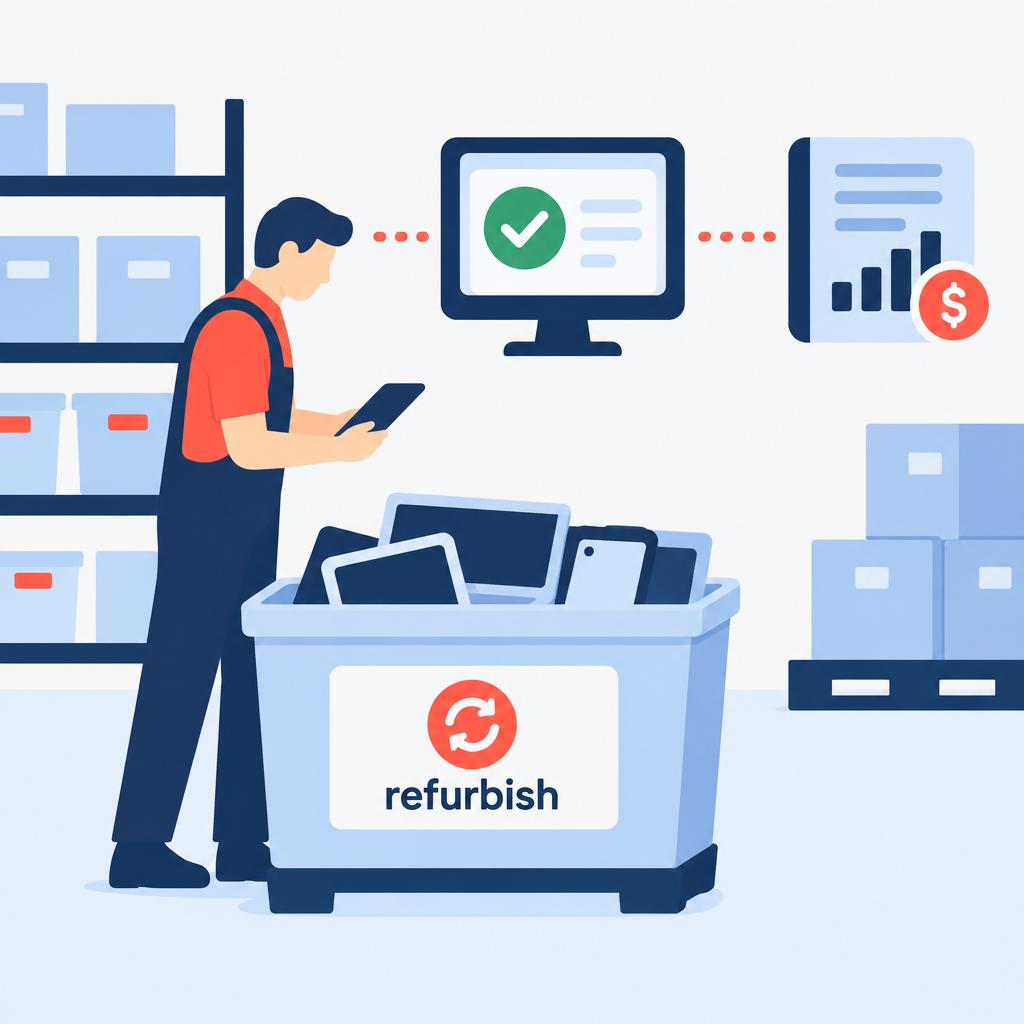
For example, imagine a company that receives a customer return with photos and a carrier damage note. The automation imports the return, recognises the SKU and uses AI to identify crushed packaging and exposed product. The rule engine marks the condition as “repairable” and suggests “refurbish” with a refurbishment code. Because the refurbishment cost is below the automated-approval threshold, the system updates WMS to place the item into a refurbishment bin and posts a provisional inventory hold to the ERP. If the cost were higher, the item would be routed to finance for approval. Every action is recorded so inventory and accounting records match the physical outcome.
Intégrations
Systèmes types
Typical systems we connect include ERP systems (SAP, Microsoft Dynamics 365, Oracle NetSuite and others), WMS platforms, e‑commerce platforms and returns portals, and the ticketing or quality systems your warehouse uses. Other systems can potentially be connected if they expose APIs, webhooks, file exports or agreed access methods. Final compatibility is confirmed during scoping.
Méthodes de connexion
Connections are implemented using available APIs or webhooks when systems support them. Where APIs are not available, integrations can use secure CSV exports, SFTP uploads, email ingestion or a middle-layer integration platform agreed before launch. Image and attachment handling is supported via direct upload endpoints or by linking files from your cloud storage provider.
Ce que nous attendons de votre entreprise
Before launch we agree which systems to connect, sample data flows (return forms, photo uploads, carrier notes), your ERP/WMS update methods and the disposition/approval rules you want enforced. We also need a list of SKUs, mapping to inventory codes and the accounting codes used for write-offs and adjustments. Access method and data requirements are agreed before implementation and confirmed during scoping.
FAQ
Which systems can you connect to for inventory updates?
We typically connect to ERP and WMS systems via their APIs, or use agreed file exports/SFTP when an API is unavailable. Final compatibility and the preferred method are confirmed during scoping.
How accurate is the AI classification of photos?
AI classification is tuned to your product types and the evidence you supply. During onboarding we train and refine models with sample images and set conservative thresholds; implementi.ai monitors performance and updates models as needed.
Can the service create accounting entries automatically?
Yes — when an integration path is agreed we can create the required adjustment or write-off records in your accounting or ERP system. The exact fields and codes used are configured to match your chart of accounts and approval rules.
What happens to cases the automation cannot decide?
Ambiguous or high-cost cases are routed to a configurable exception queue with all evidence and recommended actions for a human approver. implementi.ai monitors these queues and resolves recurring integration or mapping problems.
Quel est le niveau de personnalisation requis ?
We configure disposition rules, approval thresholds and SKU mappings to your business during implementation. Some customisation is required to align finance codes, refurbishment workflows and exception routing—this is confirmed and priced before launch.
Comment entamer la mise en œuvre ?
We begin by agreeing the systems to be connected, providing sample data and confirming disposition rules. Launch time depends on integrations, data access and scope; implementi.ai confirms timing and milestones during the scoping phase.
Prix
Les frais d'activation couvrent la configuration initiale, la mise en œuvre et le lancement du périmètre d'automatisation convenu.
L'abonnement mensuel couvre l'exploitation, la maintenance et la gestion courantes du service d'automatisation.
L'étendue exacte de l'offre et le montant définitif de l'abonnement mensuel sont confirmés avant le lancement.
Prêt à automatiser ce processus ?
Tell us which ERP/WMS and returns platforms you currently use and how you capture return evidence.
Nous vous confirmerons les modalités de mise en place de cette solution, son champ d'application et le montant final de l'abonnement mensuel.
Réservez un appel de 30 minutes
| Envoyez-nous un e-mailcontact@implementi.ai | Appelez-nous+48 660 983 178 |