

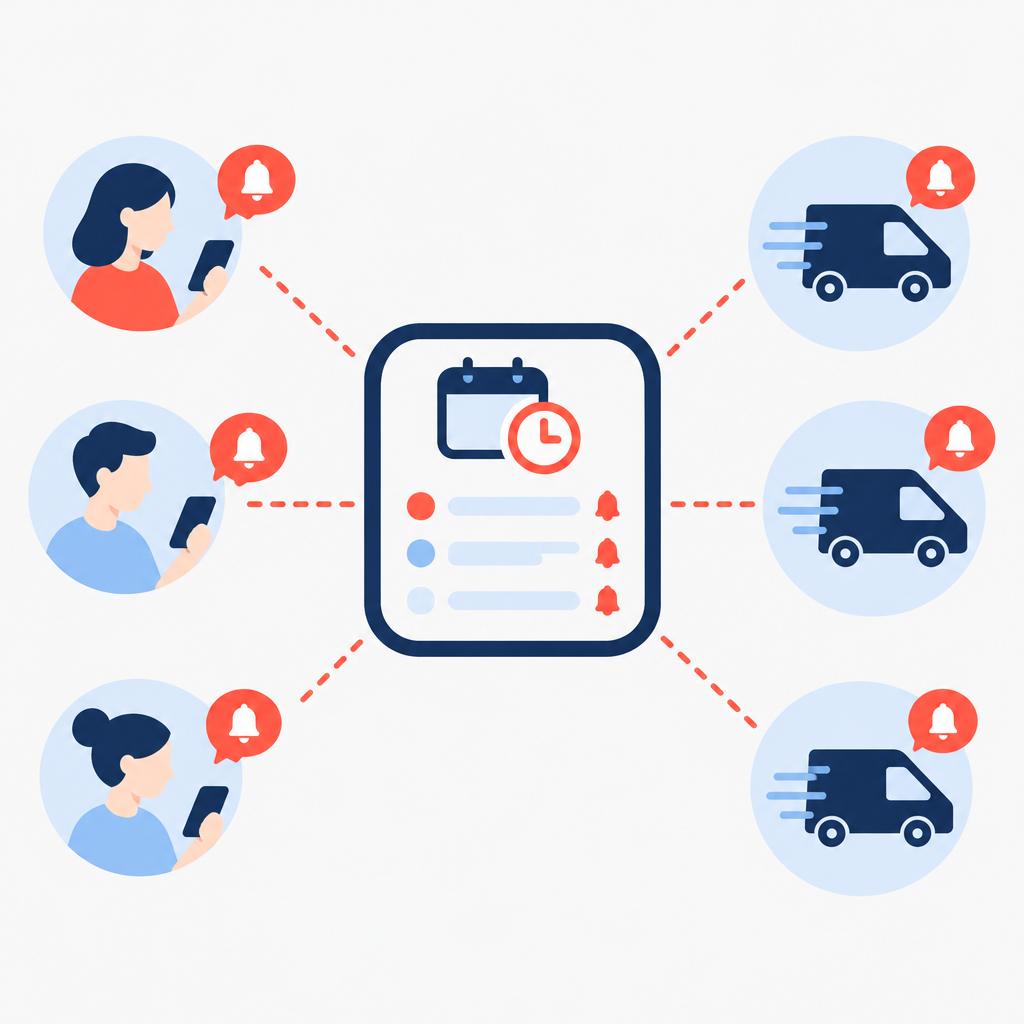
描述
This managed automation predicts delivery ETAs, consolidates outbound shipments where useful and automatically notifies customers when delivery times change. implementi.ai configures the data connections, trains the ETA model on your history and operates the automation as an ongoing service.
The product reduces manual carrier checks and reactive customer messages by continuously monitoring order status, carrier updates and internal fulfilment signals to keep customers informed and operations focused on exceptions.
问题
Without automation, teams chase carriers, check multiple dashboards and send one‑off emails or SMS to update customers. ETAs often drift because carrier updates, cutoffs and local fulfilment delays are scattered across files, WMS and courier portals. As shipment volumes grow the manual process becomes time consuming, inconsistent and error‑prone: customers receive conflicting ETAs, support receives more tickets, and operations spends capacity on routine updates instead of exceptions.

该解决方案实现了哪些自动化功能
This service continuously ingests outbound order and shipping-event data, applies an ETA prediction model tuned to your environment and then performs automated actions to improve delivery communication and routing decisions.
- Predicts delivery windows and expected arrival times for each outbound order.
- Consolidates or flags shipments when carrier schedules or cutoffs make combined routing beneficial.
- Automatically sends customer ETA notifications and updates via email/SMS or your chosen channel.
- Creates actionable exceptions and work items for orders with high ETA risk or conflicting carrier events.
- Maintains a delivery history and model feedback loop to improve predictions over time.
您的企业将获得什么
- Fewer support contacts. Customers receive timely, consistent ETA updates so support teams spend less time answering routine shipping questions.
- More reliable promises. Predictive ETAs reduce the gap between promised and actual arrival windows, improving customer satisfaction and lowering refund/compensation risk.
- Operational focus on exceptions. Automation highlights only the shipments that need human review, freeing fulfilment teams to resolve real problems faster.
- Smarter carrier decisions. Consolidation and routing suggestions help reduce shipping costs and avoid repeated small parcel runs when carriers’ schedules allow batching.
- Continuous improvement. Maintained delivery history and feedback loops refine ETA accuracy as your data volume grows.

一个实际应用案例
For a mid‑sized online retailer shipping several hundred orders per day across multiple carriers, predicting accurate ETAs is a daily strain. The retailer connects order and fulfilment data plus carrier event feeds. The automation predicts per‑order ETAs, automatically notifies customers at booking, when a carrier reports a delay and when an improved ETA is available. High‑risk orders are routed to an exceptions queue for manual review. Over time the system learns typical transit patterns and the operations team spends far less time on routine tracking while customer messages fall and delivery promises become more dependable.
为谁而设?
- Mid‑market e‑commerce retailers with multiple carriers — need consistent customer ETA updates and fewer support enquiries.
- 3PLs and distributors — want automated ETA estimation across client shipments and a single notification channel.
- Operations teams using ERP/WMS and multiple carrier APIs — benefit from consolidated shipment status and exception routing.
月度服务包含哪些内容
The monthly subscription covers the managed automation and ongoing operational tasks required to keep it running and improving.
- Configuration, operation and maintenance of the automation connecting agreed systems.
- AI processing for ETA prediction and rule application.
- Monitoring of the automation’s operation and handling/fixing integration or data errors.
- Reasonable configuration updates to adjust rules, notification templates or routing logic as business needs change.
何时可能不需要此解决方案
- Companies with very low shipment volumes (fewer than a handful per week) where manual tracking is trivial.
- Operations that already have a real‑time, validated carrier‑provided ETA and a tightly integrated TMS with equivalent notification capabilities.
工作原理
- Data connection and onboarding. We connect agreed sources — order feed, WMS/ERP shipment records and carrier event APIs or shipment exports — and map the fields needed to predict transit times and delivery windows.
- Historical model warm‑up. The service ingests historical delivery and carrier data to calibrate the ETA prediction model for your lanes and carriers.
- Real‑time monitoring and prediction. Live orders and carrier events are processed to produce an ETA and a delivery‑confidence score for each shipment.
- Notification and routing rules. Configured rules determine which ETA updates are sent to customers and when, and which shipments are flagged for consolidation or manual review.
- Exception handling and work items. High‑risk or conflicting events generate an exceptions queue with suggested actions for operations or customer service.
- Continuous feedback loop. Actual delivery outcomes feed back into the model and rules so ETA accuracy and routing suggestions improve over time.
- Ongoing operations and maintenance. implementi.ai monitors the automation, fixes connection errors and performs reasonable configuration updates to keep outputs aligned with your business rules.
工作流示例
For example, imagine a company that ships 500 parcels daily using two regional couriers and a national carrier. An order enters the ERP with fulfilment scheduled; the automation predicts an ETA window based on carrier lane performance, pickup cutoffs and the warehouse dispatch time. If the predicted ETA slips beyond the promised window, the system automatically sends a targeted SMS and email to the customer with a revised arrival window. If several orders to the same postcode can be batched without breaking SLAs, the automation suggests consolidation to operations. Any shipment where carrier events conflict with the predicted ETA is routed to an exceptions queue for manual review, ensuring teams only act on true problems.
集成
典型系统
Typical systems that can be connected include e‑commerce platforms (Shopify, WooCommerce, Magento), ERP and WMS systems that hold order/dispatch data, carrier APIs or courier portals (DHL, UPS, DPD, regional carriers) and delivery‑management/TMS platforms or carrier aggregators (EasyPost, Shippo) as examples. Other systems can potentially be connected by agreement; final compatibility is confirmed during scoping.
连接方法
We connect via available APIs or webhooks where possible. When APIs are not available, integrations can use secure CSV/SFTP exports, scheduled data pulls, email‑based shipping event exports or Google Sheets agreed during the onboarding. The final connection method is chosen per system and confirmed before implementation.
我们希望贵公司能提供以下内容
Before launch we agree the systems to connect, a sample of historical shipping and carrier event data (to tune predictions), carrier API credentials or export access, and the notification channels you want to use. We also need your decision rules for notifications and any consolidation or priority rules. Compatibility and the exact access method are confirmed during scoping and before work begins.
常见问题解答
Which shipping and order systems can you connect to?
We typically connect to e‑commerce platforms (Shopify, WooCommerce, Magento), ERPs and WMS systems and carrier APIs or courier portals. If a system exposes an API, webhook, scheduled export or SFTP/CSV, we can usually integrate it — final compatibility is checked during scoping.
How customizable are the notification templates and timing?
Notification content, cadence and channels are configurable during onboarding. implementi.ai will implement the agreed templates and adjust timing rules as part of reasonable monthly configuration updates.
What happens when carrier data conflicts with the predicted ETA?
Conflicting events are routed to an exceptions queue with suggested actions and supporting data. The automation only performs predefined customer notifications; human review is used for high‑risk or ambiguous cases according to your rules.
Do I need to provide historical delivery data?
Historical shipping records are highly recommended to train and calibrate ETA predictions. If limited history exists, the system still runs but prediction accuracy improves as more delivery outcomes are collected.
是什么因素影响了月度价格?
Price reflects the number and complexity of integrations, frequency of processing, data volume, need to maintain delivery history and the expected ongoing monitoring and support. We confirm the final scope before launch.
如何开始实施?
We begin with a scoping call to review systems, data availability and business rules. After confirming access methods and scope we schedule onboarding steps; exact timelines depend on integrations and agreed scope.
价格
激活费涵盖商定的自动化范围的初始配置、实施和上线工作。.
月度订阅费用涵盖了自动化服务的日常运行、维护和管理。.
具体范围和最终的月费将在上线前确定。.
准备好将此流程自动化了吗?
Tell us which e‑commerce, WMS/ERP and carrier APIs you currently use and your average daily shipment volume.
我们将确认该解决方案的接入方式、适用范围以及最终的月度订阅费用。.
| 给我们发电子邮件contact@implementi.ai | 请致电我们+48 660 983 178 |