描述
This managed automation continuously evaluates open production orders, material availability and delivery priorities to produce an operationally actionable production sequence and material pull instructions. Implementi.ai configures, operates and maintains the solution so your operations team receives reliable, explainable recommendations every day.
The service reduces time spent on manual sequencing meetings, stops last‑minute expediting and creates a single, auditable sequence that downstream systems and operators can consume. Final configuration — which rules, priorities and exceptions apply — is agreed before launch and updated as your needs evolve.
问题
Production planners typically juggle spreadsheets, emails and ERP screens to decide which jobs run when. As volume and product variety grow, manual sequencing becomes slow and inconsistent: high‑priority customer jobs are delayed, parts shortages are discovered late, and teams resort to reactive overtime and expedited purchases. The lack of a continuous, single source of truth for order priorities creates repeated firefighting on the shop floor and poor utilisation of constrained resources like bottleneck machines or limited skids of components.

该解决方案实现了哪些自动化功能
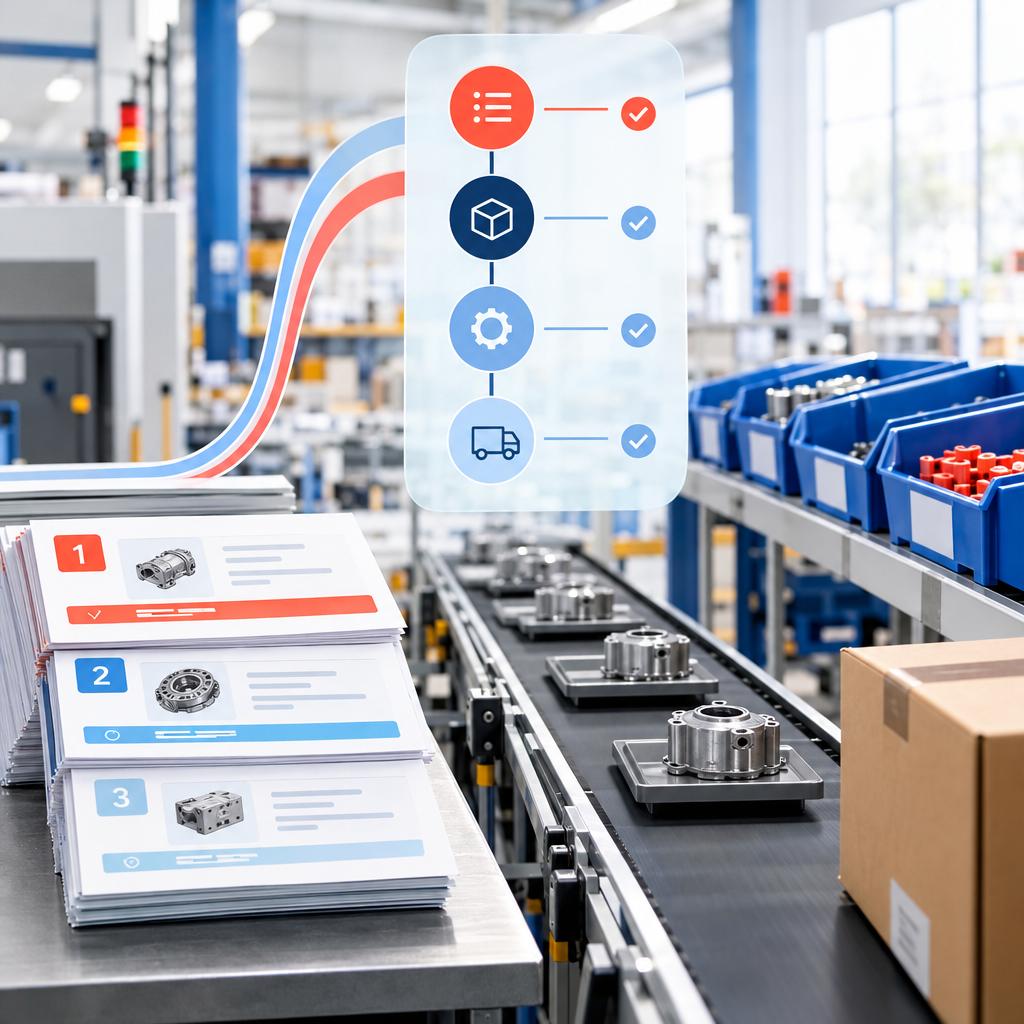
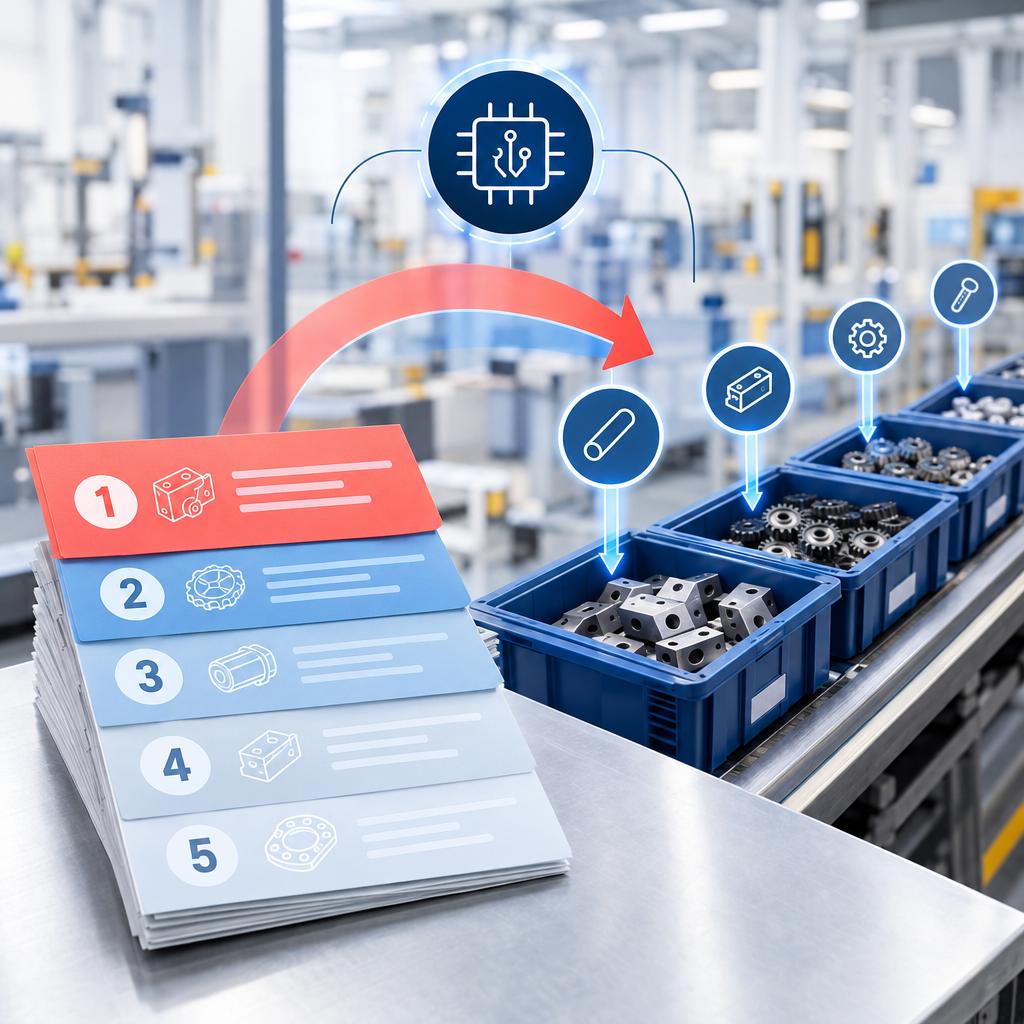
This product automates continuous prioritisation of work orders and generation of material pull instructions aligned to agreed business rules. It produces a single, ranked production sequence and actionable pick/pull tasks for warehouse or kitting teams, and routes exceptions for human review.
- Continuous scoring of open production orders using due date, customer priority, lead time and resource load.
- Material availability checks and automated pull suggestions to kitting/WMS when parts are present.
- Auto‑creation of flagged exceptions (shortages, sequencing conflicts) routed to planners.
- Exported sequence and pull lists to ERP/MES/WMS or CSV/Google Sheets for consumption.
- Periodic re‑sequencing (daily or on trigger) and audit history of decisions.
您的企业将获得什么
- Reduced expediting. Automated sequencing surfaces conflicts early and creates consistent priorities, reducing last‑minute rushes and emergency purchases.
- Faster planning cycles. Continuous scoring removes repeated manual rework and gives planners a trusted starting sequence each shift.
- Improved material flow. Material pull instructions reduce kitting delays and ensure parts are staged when production needs them.
- Explainable decisions. Each sequencing decision is accompanied by the rule and inputs used so operations teams can understand and adjust priorities quickly.
- 降低运营风险。. Exception routing ensures true blocking issues are handled by the right person rather than being lost in email or chat.

一个实际应用案例
A mid‑sized manufacturer runs dozens of concurrent production orders across two bottleneck machines and a shared kitting area. Planners spend mornings manually reordering jobs to fit urgent customer requests, then discover parts shortages mid‑shift. With this product, the system continuously ranks orders by agreed priorities, checks material availability and produces a daily sequence plus a kitting pick list. Shortages are flagged and routed to procurement with the production impact explained, reducing surprise stoppages and enabling the floor supervisor to run the agreed sequence without ad‑hoc changes.
为谁而设?
- Discrete manufacturers with constrained bottleneck resources who need clearer sequencing and fewer expedites.
- Operations teams using ERP/MRP or MES that want automated, auditable production sequences and material pull lists.
- Plants that experience frequent part shortages and want earlier exception detection and routing.
- Manufacturers scaling from single to multi‑shift production where manual sequencing no longer keeps up with demand.
月度服务包含哪些内容
The monthly subscription covers a fully operated automation: we build and run the sequencing and pull‑list service, keep integrations healthy, monitor performance and handle errors or adjustments as operations change.
- Configuration and ongoing maintenance of the sequencing rules and thresholds.
- Connections with agreed systems (ERP/MES/WMS) and routine monitoring of the automation’s operation.
- Handling and fixing integration errors and updates required to keep the solution working.
- Reasonable configuration updates to reflect new priorities, calendars or resource changes.
何时可能不需要此解决方案
- Organisations with only occasional single‑job production where manual sequencing is already trivial.
- Teams without any digital inventory or order data; the solution requires machine‑readable order and parts information to operate.
工作原理
- 连接并导入。. We connect to your ERP/MES/WMS or agreed data export and ingest open production orders, BOMs, stock levels and resource calendars. Data access and fields are agreed before launch.
- Normalise and map. The service maps your order, item and resource identifiers to a consistent model and applies the agreed priority rules (customer SLAs, due dates, order value, etc.) so different systems speak the same language.
- Score and sequence. Each open order is scored against the configured rule set and resource constraints; the system produces a ranked production sequence that respects machine capacity and planned downtime.
- Check material availability. The sequencer verifies on‑hand stock and earmarked components, then creates material pull/kitting suggestions for jobs that can run; shortages are identified and flagged.
- Publish and integrate. The final sequence and pull lists are exported to your MES/WMS/ERP or delivered as CSV/Google Sheet; downstream teams receive a single authoritative plan for the shift.
- 路线例外情况。. Any jobs blocked by shortages, missing routings or capacity conflicts are routed to named planners or procurement with contextual information for quick resolution.
- 进行监控和迭代。. The automation runs at the agreed cadence (daily or on triggers), logs sequence changes and is monitored by implementi.ai; we handle error fixes and reasonable configuration updates.
工作流示例
For example, imagine a company that manufactures assemblies for multiple customers and has a single CNC cell that limits throughput. Each morning the automation reads open orders from the ERP, BOMs and current inventory. It scores orders using customer priority, promised date and setup time, then creates a ranked run list that maximises on‑time deliveries while minimising setups. The system checks stock for each job and generates a kitting pick list for those ready to run; if a job lacks a critical component, the automation creates an exception and routes it to procurement with the expected production impact. The published sequence is consumed by the MES and the shop‑floor team runs the agreed order list for the shift.
集成
典型系统
Typical systems we connect to include ERP and MRP platforms (for example SAP S/4HANA, Oracle NetSuite, Microsoft Dynamics 365, Odoo), shop‑floor MES or scheduling tools, and WMS or inventory systems. Other systems can potentially be connected via agreed APIs, webhooks or file exports; final compatibility and scope are confirmed during onboarding.
连接方法
Common connection methods include direct API integrations to ERP/MES, webhooks from scheduling systems, secure CSV or Excel exports, Google Sheets, or an agreed database read. If a native integration is not available, we work with your IT team to agree a reliable export or intermediary API layer before launch.
我们希望贵公司能提供以下内容
Before launch we agree which systems contain orders, BOMs, stock levels and resource calendars; the specific fields and access method for each integration; the priority and exception rules you want applied; and who should receive exception routes. We also agree the cadence (e.g. daily re‑sequence, on order change) and the export format for the final sequence. Compatibility, data access and exact triggers are confirmed as part of the pre‑launch design.
常见问题解答
可以与哪些系统进行集成?
We typically integrate with ERPs, MRP/MES systems and WMS platforms via APIs or file exports. Exact compatibility is confirmed during the onboarding review and we work with your IT to select the most reliable connection method.
How are sequencing priorities set and changed?
Priorities are configured from a ruleset you approve (due dates, customer priority, order value, setup cost, etc.). Implementi.ai maintains and applies the rules and can update them as your business needs evolve under the monthly service.
What happens when a shortage is detected?
The service flags the shortage, explains which orders are affected and routes the exception to the agreed person or team (procurement, planner) with contextual data so they can act quickly.
Can the sequence be exported to our MES/WMS?
Yes — we publish the final sequence and pull lists to the agreed target: API endpoint, CSV/Excel feed, Google Sheet or an MES/WMS import. The exact export format is configured during implementation.
How often does the system re‑sequence orders?
Cadence is agreed before launch — typical setups run daily, nightly or on major triggers such as receipt of a high‑priority order or a stock change. Frequency can be changed as operational needs require and is part of the managed service.
Who operates and fixes the automation?
Implementi.ai operates the automation, monitors its health, and handles integration errors and reasonable configuration updates as part of the monthly subscription.
价格
激活费涵盖商定的自动化范围的初始配置、实施和上线工作。.
月度订阅费用涵盖了自动化服务的日常运行、维护和管理。.
具体范围和最终的月费将在上线前确定。.
准备好将此流程自动化了吗?
Tell us which ERP, MES or WMS systems you use and describe a recent production bottleneck you want fixed.
我们将确认该解决方案的接入方式、适用范围以及最终的月度订阅费用。.
| 给我们发电子邮件contact@implementi.ai | 请致电我们+48 660 983 178 |