

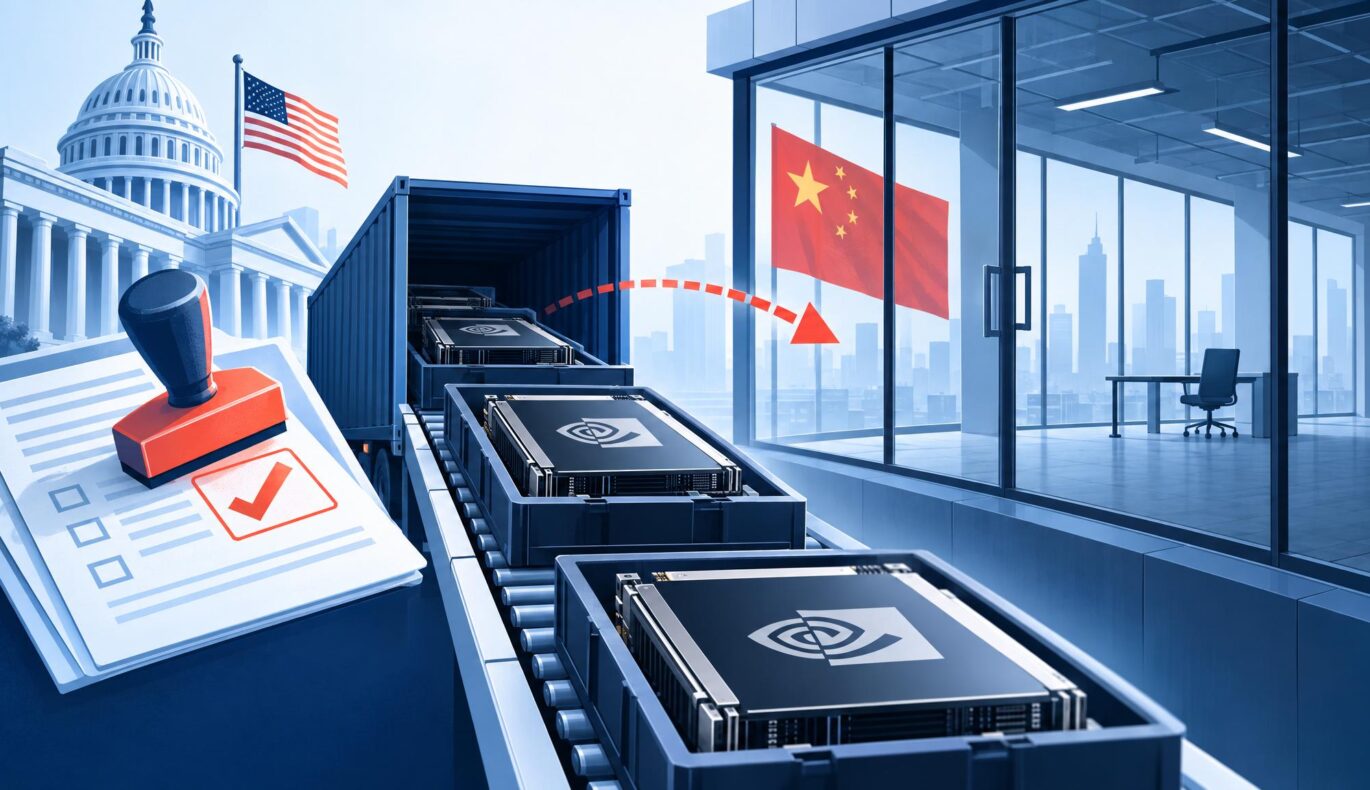
The US government reportedly allowed Nvidia H200 artificial-intelligence chips to be handled by a Chinese company whose listed office appeared empty, according to reporting cited by The Verge and The New York Times. The case raises questions about how the Commerce Department and Nvidia vet Chinese firms approved for access to advanced chips—and whether export controls can work if the recipient’s real operations are unclear.
What the Nvidia–New Matrix case shows
New Matrix was reportedly included on a list of Chinese firms approved to handle Nvidia’s H200 chips. The New York Times found little evidence that the company operated meaningfully: its listed premises were described as an unfinished, largely empty office, and only scant information was available online about the company, which was created 17 months ago.
That establishes a vetting concern, not necessarily proof that Nvidia H200 chips were delivered to New Matrix or that the company diverted them. The supplied reporting does not confirm a shipment, the volume involved, the approval process used, or whether US officials or Nvidia have changed their procedures.
Why H200 chip oversight matters
The H200 is an Nvidia AI accelerator, but the source material does not explain the specific technical capabilities, deployment conditions, or permitted use associated with New Matrix. It also does not describe a new feature, software rollout, consumer availability, or general eligibility programme. The central issue is control of a high-value AI hardware supply chain: regulators need confidence that an approved recipient is a real organisation able to account for the chips.
Security and compliance risks are implied rather than demonstrated in this report. An inadequately checked recipient could make it harder to track where restricted hardware goes, who operates it, and whether it reaches an unauthorised end user. The source does not establish that any such transfer occurred in this case.
Implications for AI teams and suppliers
For developers and businesses buying AI capacity, the story is a reminder that hardware provenance is part of technical risk management, not merely a government-policy issue. A team depending on an overseas infrastructure partner could reasonably ask for evidence of the provider’s legal identity, physical operations, chip custody, and export-control responsibilities before committing to a long-term arrangement.
For Nvidia, distributors, and smaller intermediaries, stronger customer checks may add friction and delay legitimate deployments, but weak checks can expose the supply chain to regulatory action and reputational damage. Hypothetically, a European AI company sourcing capacity through a newly formed partner in China might need more documentation and audit rights if that partner’s operational footprint cannot be independently verified.
The immediate practical step is caution rather than assuming a policy change. New Matrix’s status, whether H200 hardware was actually supplied, and the responses from Nvidia and the US Commerce Department remain unresolved in the supplied material.
Fuente: Reportaje original. Este artículo incluye un contexto editorial independiente y un análisis práctico.
Más información sobre la IA: Echa un vistazo a nuestra Últimos artículos sobre automatización y tecnología de IA, o echa un vistazo a soluciones de automatización listas para usar.